Where The Naira Stands Right Now
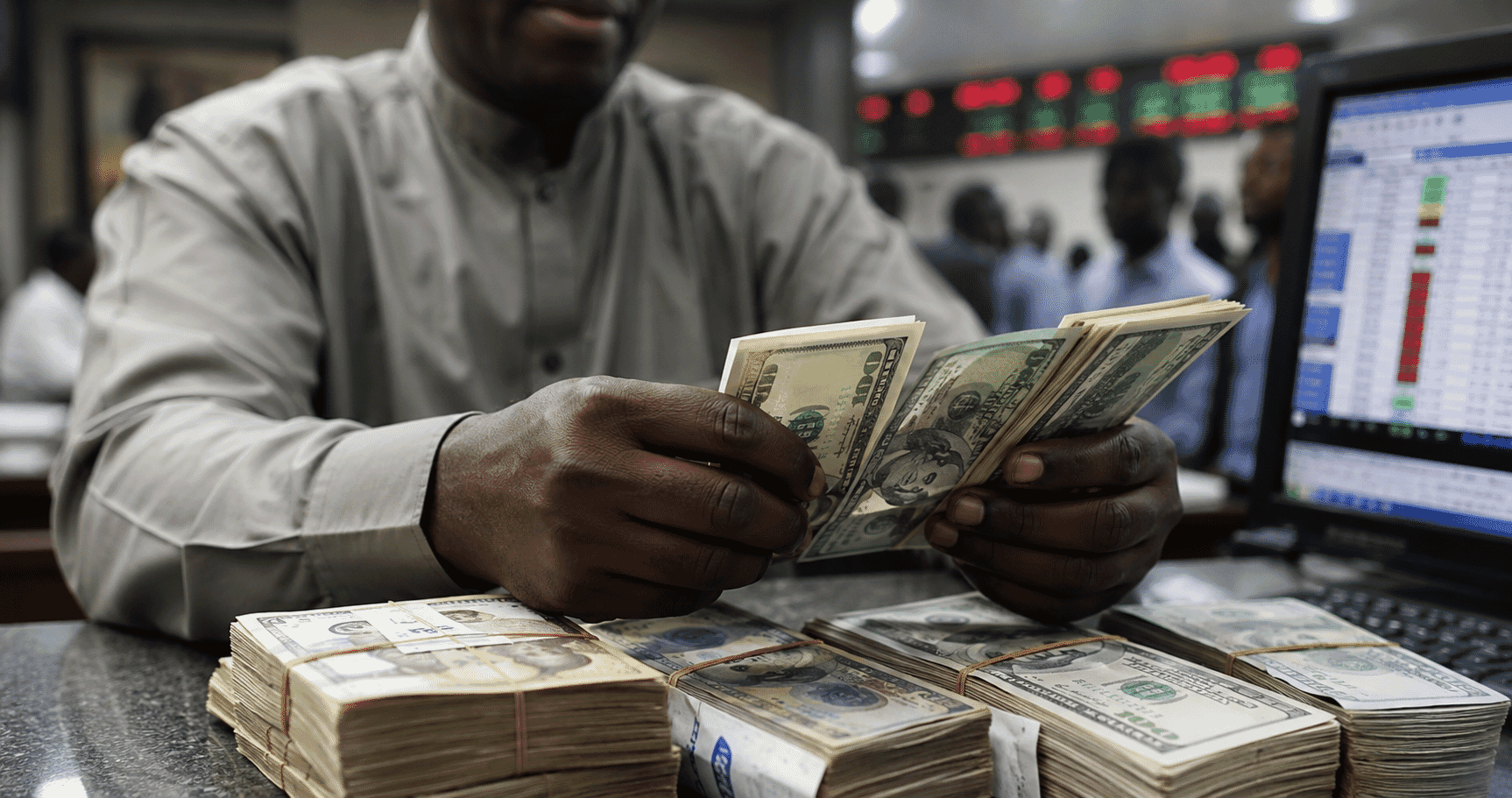
The official Nigerian Foreign Exchange Market, known as the NFEM, priced the dollar at roughly ₦1,367 on Tuesday. That figure comes from the CBN's volume-weighted average of completed interbank transactions, the same methodology the bank has used since it unified its exchange-rate windows in 2023.
Meanwhile the picture looks different on the street. Bureau de Change operators and parallel-market dealers in Lagos, Abuja and Kano were quoting the dollar at around ₦1,400 for selling and ₦1,385 for buying. That leaves a spread of roughly ₦33 between the formal and informal markets, a gap analysts describe as narrow by historical standards but still wide enough to matter for anyone actually trying to source dollars outside a bank.
For context, the naira closed Monday, July 6, at ₦1,370.33 officially, with the black market unchanged at ₦1,400. So Tuesday's move represents a modest appreciation in the formal window even as the parallel market held firm.
Why The Official And Black Market Rates Keep Diverging
This isn't a new phenomenon, but it's worth explaining plainly because it confuses a lot of readers who assume there's just one dollar rate. The NFEM rate reflects transactions between banks and authorised dealers under CBN oversight.
The parallel market, by contrast, is an unregulated network of street traders and BDC operators serving individuals and small businesses who can't easily access the official window or need cash quickly.
When the gap narrows, as it has in recent weeks, it typically signals improved liquidity and confidence that reforms are working as intended. When it widens sharply, as happened briefly in early July when the black market touched ₦1,415 before easing back, it usually points to fresh demand pressure or seasonal dollar scarcity outside formal banking channels.
Muda Yusuf, chief executive of the Centre for the Promotion of Private Enterprise, frames the broader goal simply. He has argued that exchange-rate stability is a two-way objective, meaning the central bank must guard against runaway appreciation just as much as depreciation, since a naira that strengthens too fast can undercut local manufacturers competing against cheaper imports.
The Reserves Story Behind The Numbers
Nigeria's external reserves climbed to $51.52 billion as of July 3, 2026, according to CBN data reported by Daily Post, extending a build-up that has defined the FX market for much of the year. That figure actually hit the CBN's own 2026 target of $51.04 billion weeks ahead of schedule, a projection the bank first laid out in its macroeconomic outlook at the end of 2025.
To put that in perspective, gross reserves stood at roughly $37.7 billion in the corresponding period of 2025, meaning they've grown by more than 35 percent year on year.
 OPay Security Features Activate Emergency Lock and Safety PIN to Protect Customer Accounts
Much of that accumulation traces back to stronger oil earnings, sovereign bond issuance, diaspora remittances and a wave of foreign portfolio investment that pushed capital importation to $10.37 billion in the first quarter of 2026 alone, an 83.8 percent jump from the same period a year earlier, according to National Bureau of Statistics data.
Reserves matter because they're the CBN's ammunition. A well-stocked reserve position gives the bank room to intervene directly in the FX market when the naira comes under pressure, smoothing out volatility rather than letting the currency swing wildly on any given day.
The Reform Driving The Numbers: CBN's Foreign Exchange Manual 2026
Much of this year's relative calm traces back to the fourth edition of the CBN's Foreign Exchange Manual, which took effect June 1, 2026. The manual requires all interbank spot transactions to run through an approved electronic trading system, tightens net open position limits for banks, and allows authorised dealers to settle spot transactions with non-resident clients in any acceptable foreign currency within two business days.
Compared with earlier frameworks that left the market fragmented across CBN, interbank and BDC windows with wildly different rates, this consolidated approach is designed to improve price discovery and squeeze out the arbitrage opportunities that plagued the naira for years.
It builds on the October 2023 unification of exchange-rate windows and the 2024 launch of an electronic FX matching system, both of which analysts credit with restoring a measure of market credibility.
The practical effect for ordinary Nigerians is less obvious day to day, but it shows up in the narrowing gap between official and parallel rates and in banks' improved capacity to fulfil dollar requests for travel, school fees and business imports without months-long delays.
Is The Naira Actually Undervalued? What The Experts Say
Here's where the analysis gets genuinely contested. Bismarck Rewane, managing director of Financial Derivatives Company, has estimated the naira's fair value using purchasing power parity at roughly ₦1,256.79 to the dollar, suggesting the currency remains undervalued by about 11 percent even at its improved official rate.
He has noted that currencies typically converge toward their PPP-implied values over a five-year horizon, meaning today's ₦1,367 rate may still have room to strengthen if reforms hold.
Not everyone frames the recovery the same way. Dr. Yemisi Ayinde of Covenant University has cautioned against attributing the naira's gains purely to domestic policy, arguing that exchange rates are ultimately relative asset prices shaped by interest rate differentials, capital mobility, sovereign risk premia and monetary credibility rather than any single reform. She points out that the dollar still dominates global reserves and trade invoicing, limiting how much any one currency's local story can shift.
That tension, between crediting the CBN's reforms and crediting external factors like oil prices and a softer dollar globally, is likely to keep shaping the debate through the rest of 2026.
Historical Context: How Far The Naira Has Fallen And Clawed Back
Zooming out helps explain why ₦1,367 feels almost like good news to many Nigerians. The naira traded near parity with the dollar in the 1980s before a series of devaluations reshaped the currency entirely. Under military rule in the 1990s, the official rate sat around 22 naira to the dollar even as the black market already traded near 88.
By 2009, the naira had slid to between 127 and 147 to the dollar across various windows. It held in a comparatively stable 148 to 164 range through the mid-2010s before a fresh wave of pressure, driven by oil price crashes and policy restrictions, pushed it into freefall.
The most dramatic collapse came in 2023 and 2024, when the naira briefly traded above ₦1,900 on the parallel market amid the unification of exchange windows and the removal of a costly fuel subsidy. Measured against that backdrop, today's ₦1,367 official rate represents a meaningful recovery, even if it remains far weaker than the currency's pre-2015 levels.
Pros, Cons And Real-World Limitations Of The Current Stability
The upside is fairly straightforward. Improved liquidity has helped importers and manufacturers plan with more confidence, inflation pressures tied to FX scarcity have eased somewhat, and the Monetary Policy Committee felt comfortable cutting its benchmark rate to 26.5 percent in February 2026, a signal that officials see less immediate FX-driven inflation risk.
But the stability has real limits. The CBN's own tightrope, deliberately slowing the naira's appreciation to avoid an unsustainable rally, means gains can feel artificially capped even when fundamentals point stronger.
Farmers and domestic producers have reported that duty waivers on imported food, part of the broader stabilization push, have made it harder to compete on price, raising longer-term food security questions even as headline inflation cools.
And the International Monetary Fund has flagged that continued reserve accumulation may be slowing the pace at which the naira adjusts toward its true equilibrium value, effectively trading short-term calm for delayed price discovery.
There's also the honest caveat that gross reserve figures can overstate what's actually usable. As recently as 2023, swap arrangements and short-term obligations tied up so much of Nigeria's reserves that net usable buffers sat below $4 billion despite headline numbers looking healthier.
That specific structural risk has reportedly improved considerably since, but it underscores why analysts urge caution before declaring the reserve story fully resolved.
Public Sentiment on X Reflects Everyday Anxiety and Historical Memory
Nigerians took to X on July 7 with real-time queries such as “How much is dollar to naira rn?” alongside pointed observations. One auto dealer noted that “Dollar/Naira rate is what needs to drop for further reduction in car prices,” linking forex levels directly to consumer goods affordability. Others recalled the ₦100+ era of 2005, underscoring how far the currency has traveled and the cumulative impact on living standards.
These reactions reveal both immediate practical concerns and deeper frustration with structural outcomes. They also show strong public engagement with daily rate movements, turning forex updates into national conversation topics.
Read More
![Aliko Dangote]() Dangote Rejects NNPC Bid to Raise Stake in $20 Billion Refinery, Eyes Public Listing for Nigerians
Dangote Rejects NNPC Bid to Raise Stake in $20 Billion Refinery, Eyes Public Listing for Nigerians-
![Dangote Refinery]() SEC Bans Dangote Refinery IPO Marketing, Orders Refunds Within 24 Hours
SEC Bans Dangote Refinery IPO Marketing, Orders Refunds Within 24 Hours ![Taiwo Oyedele]() Tax Acts 2025: Federal Government Releases Final Transition Guidelines for Nigeria's New Tax Regime
Tax Acts 2025: Federal Government Releases Final Transition Guidelines for Nigeria's New Tax Regime![CBN Building]() CBN Orders Banks, Fintechs to Disclose Ultimate Beneficial Owners in Sweeping Payments Overhaul
CBN Orders Banks, Fintechs to Disclose Ultimate Beneficial Owners in Sweeping Payments Overhaul
 Dangote Rejects NNPC Bid to Raise Stake in $20 Billion Refinery, Eyes Public Listing for Nigerians
 SEC Bans Dangote Refinery IPO Marketing, Orders Refunds Within 24 Hours
 Tax Acts 2025: Federal Government Releases Final Transition Guidelines for Nigeria's New Tax Regime
 CBN Orders Banks, Fintechs to Disclose Ultimate Beneficial Owners in Sweeping Payments Overhaul