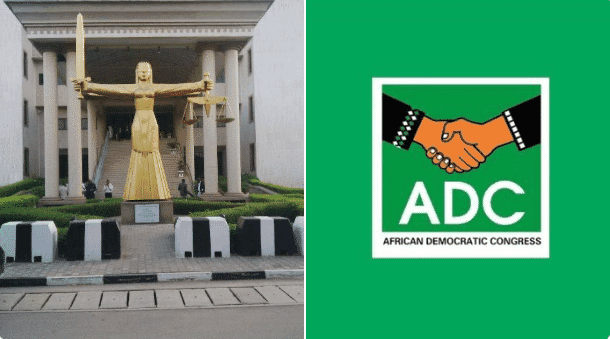
A Federal High Court in Abuja ordered the Independent National Electoral Commission (INEC) on Monday, June 15, 2026 to immediately deregister the African Democratic Congress (ADC), Accord Party, Action Alliance, Action Peoples Party (APP), and Zenith Labour Party (ZLP) over alleged constitutional breaches, upending the electoral futures of some of Nigeria's most prominent political figures ahead of the 2027 general elections.
The ruling lands with explosive force. Two of the biggest names in Nigerian politics, former Vice President Atiku Abubakar and Osun State Governor Ademola Adeleke, now find themselves without a platform to contest.
Justice Peter Odo Lifu of the Federal High Court in Abuja issued the deregistration order while delivering judgment in suit number FHC/ABJ/CS/2637/2026, filed by the Incorporated Trustees of the National Forum of Former Legislators against INEC and the five affected political parties.
The judgment is immediate in its effect. INEC, as Nigeria's apex electoral body, is now under a direct court mandate to remove the parties from its register of recognized political organizations.
The five parties affected by the ruling are the African Democratic Congress (ADC), Action Peoples Party (APP), Action Alliance (AA), Accord Party (AP), and Zenith Labour Party (ZLP).
 How to Buy SpaceX (SPCX) Stock From Nigeria: Best Apps and Step-by-Step Guide
What This Means for Atiku Abubakar and the 2027 Presidential Race
By the judgment, former Vice President Atiku Abubakar, who is the presidential candidate of the ADC, now has no platform on which to contest the forthcoming presidential election.
Atiku had been among the most visible opposition figures building momentum ahead of 2027. His defection to the ADC was seen as a strategic move to consolidate opposition forces against the All Progressives Congress (APC). That calculation now collapses with a single court order.
The ruling effectively eliminates the ADC as an electoral vehicle at the national level. Unless a successful appeal reverses the judgment before INEC acts, Atiku faces the choice of joining another registered party or sitting out the 2027 presidential contest entirely.
Adeleke's Osun Re-election Bid in Tatters
Osun State Governor Ademola Adeleke, who was billed to seek re-election on August 15 in the governorship election on the platform of the Accord Party, has also been kicked out of the race by the judgment.
This is a critical development with a precise and urgent timeline. The Osun governorship election is scheduled for August 15, 2026, giving Adeleke barely two months to find legal remedy or secure an alternative platform.
The governor's political fate now rests on whether the Court of Appeal will grant an emergency stay of execution on the deregistration order. Without such a stay, INEC is constitutionally bound to act on the Federal High Court's directive.
Who Filed the Suit and Why
The suit was filed by the Incorporated Trustees of the National Forum of Former Legislators, a group comprising former members of the National Assembly. They asked the court to order INEC to deregister ADC, Accord Party, Zenith Labour Party, and Action Alliance over alleged constitutional breaches.
The plaintiffs argued that these parties had repeatedly failed to meet the minimum performance thresholds required under Nigerian law. According to the plaintiffs, the affected parties did not secure the minimum electoral performance required to retain their registration, which includes winning at least 25 percent of votes in a state during a presidential election or securing at least one elective seat at the national, state, or local government levels.
The plaintiffs maintained that despite poor performance in the 2023 general elections and subsequent by-elections, the parties remained on INEC's register.
Attorney General of the Federation Backed the Deregistration
The Federal Government did not resist the suit. In fact, it sided with the plaintiffs in a significant legal endorsement.
In a notice filed pursuant to Order 15 Rule 1 of the Federal High Court Civil Procedure Rules 2019, the Attorney General of the Federation formally admitted the plaintiff's case to the extent of his constitutional responsibilities, maintaining that as the chief law officer of the federation, he is duty-bound to enforce the relevant provisions of the Constitution and the Electoral Act.
The Attorney General described the suit as public interest litigation aimed at safeguarding democratic integrity, noting that allowing underperforming parties to remain registered contributes to ballot congestion, increases election costs, and undermines accountability.
The government's alignment with the plaintiffs removed any prospect of a unified defense by the state. INEC and the affected parties were left to argue their cases independently.
The Constitutional Framework Behind the Ruling
The plaintiffs sought declaratory orders compelling INEC to enforce constitutional thresholds, as well as mandatory and perpetual injunctions restraining the commission from recognising or giving effect to the political activities of the affected parties pending full compliance.
The legal basis for the suit draws from Nigeria's 1999 Constitution as amended and the Electoral Act 2022. The plaintiffs maintained that continued recognition of the parties is unlawful and undermines the integrity of Nigeria's electoral system, with the forum's national coordinator, Igbokwe Raphael Nnanna, stating in the affidavit that allowing parties that have not met constitutional requirements to remain on the register is unconstitutional, illegal, and a violation of the governing legal framework.
The Electoral Act 2022 specifically empowers INEC to deregister parties that fail to meet election performance benchmarks, yet the commission had not exercised this power against the affected parties before the court intervened.
What INEC Must Do Next
The court's order is direct and binding. INEC must now take formal steps to remove the five parties from its register of recognized political parties.
The plaintiffs had warned that unless restrained, INEC might unlawfully permit the affected parties to participate in the 2027 general elections, thereby clogging ballot papers, overstretching administrative resources, and misleading voters.
The commission faces a narrow legal window. If any of the affected parties file an urgent application for a stay of execution and succeed at the appellate court, the deregistration could be temporarily suspended. Without such relief, INEC must comply with the Federal High Court judgment as delivered.
A Sweeping Impact on Nigeria's 2027 Political Landscape
Monday's ruling is one of the most consequential judicial interventions in Nigerian electoral history ahead of a general election cycle. Five political parties, several governorship candidates, and one former presidential flag-bearer are all directly caught in its sweep.
The ruling also raises urgent questions about the future of opposition politics in Nigeria. With the ADC now ordered deregistered, opposition forces that had consolidated around Atiku's candidacy must rapidly recalibrate. Any delay risks losing critical campaign time ahead of 2027.
For Governor Adeleke, the August 15 Osun election clock is ticking loudly. His legal team must either secure an appellate stay within weeks or facilitate his migration to another registered party before INEC closes nomination processes.
The National Forum of Former Legislators, through this suit, has reshaped Nigeria's political map in a single court session. The full consequences will unfold in the weeks ahead as the affected parties decide whether to fight the ruling at the Court of Appeal or navigate the political terrain without their deregistered platforms.
Read More
![Elon Musk]() Elon Musk Becomes World's First Trillionaire as SpaceX Shares Surge 23% on Nasdaq
Elon Musk Becomes World's First Trillionaire as SpaceX Shares Surge 23% on Nasdaq![Digital Switch Over]() Nigeria Digital Switchover 2026: FG Launches Nationwide DSO on June 17, Ending Analogue TV Broadcasting
Nigeria Digital Switchover 2026: FG Launches Nationwide DSO on June 17, Ending Analogue TV Broadcasting![Opay]() OPay's $4 Billion Wall Street Dream Was Built on Nigerian Wallets — So Why Are Nigerians Not Invited?
OPay's $4 Billion Wall Street Dream Was Built on Nigerian Wallets — So Why Are Nigerians Not Invited?![Cybercriminal]() Nigeria Records 281,500 Breached Accounts in Q1 2026
Nigeria Records 281,500 Breached Accounts in Q1 2026
 Elon Musk Becomes World's First Trillionaire as SpaceX Shares Surge 23% on Nasdaq
 Nigeria Digital Switchover 2026: FG Launches Nationwide DSO on June 17, Ending Analogue TV Broadcasting
 OPay's $4 Billion Wall Street Dream Was Built on Nigerian Wallets — So Why Are Nigerians Not Invited?
 Nigeria Records 281,500 Breached Accounts in Q1 2026