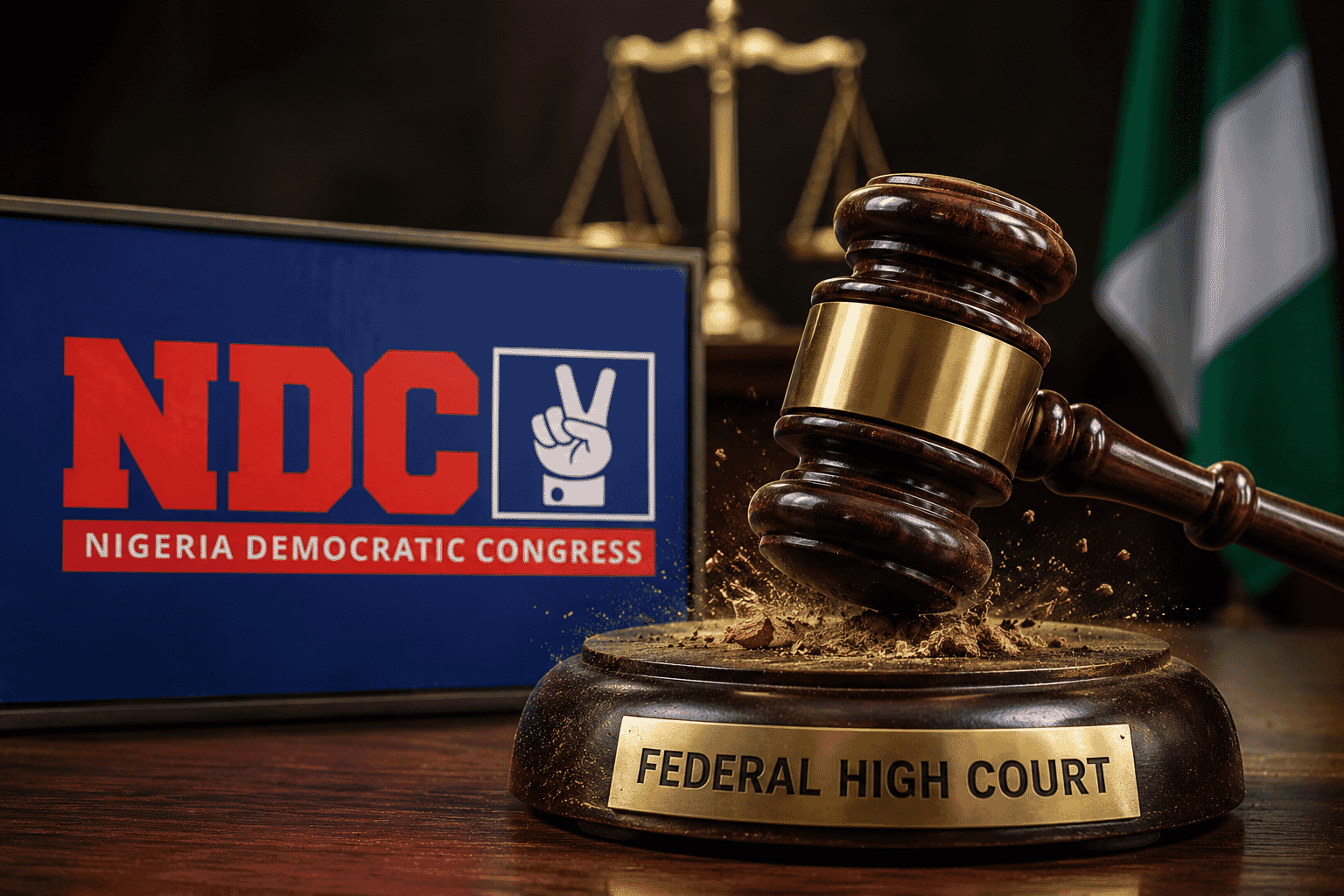
What the Court Actually Ruled
Justice Dashen did not rule that NDC can never become a party. He held that the previous judgment could not stand because all necessary parties were not before the court. That distinction matters enormously, because it separates a procedural defect from a substantive rejection.
The judge declared that all relevant parties must be heard before any substantive decision can be made in the matter, and the court upheld the Peace Movement Party's application, ruling that it was a necessary party to the suit. According to the judge, the earlier judgment was constitutionally defective because it was delivered without hearing from all interested parties, an omission he said rendered the entire process null and void.
Crucially, Justice Dashen also noted that material facts were suppressed in obtaining the 2025 judgment, making it necessary to set the decision aside. That single line elevates this from a simple joinder technicality into an allegation of procedural concealment, a far more serious charge for NDC's legal team to answer.
The Logo Dispute Behind the Reversal
At the center of the case sits a single contested image: NDC's party logo. Lawyer to the Peace Movement Party, C.S. Ekeocha, said the party approached the court after discovering that NDC's registration was based on a logo it had earlier submitted to INEC before the case began.
NDC disputes the credibility of that claim entirely. The party stated that the association filing the complaint was unknown to them, noting the Peace Movement Party is not a registered political party in Nigeria, and that it claimed in a motion, not a substantive suit or appeal, that the court should set aside its earlier judgment because in 2015 it had sought registration with a victory sign symbol and was denied.
This is the analytical crux global wire reports glossed over: PMP never had to prove it owns the logo to win this round. It only had to convince the judge it was a "necessary party" whose interests were arguably touched. Proving actual logo ownership is a separate battle that starts now, in the fresh hearing.
 State Police Bill Clears Senate, Handing Nigerian Governors New Powers Amid Funding Fears
NDC's Legal Counterattack
NDC moved within hours, framing the ruling as a jurisdictional overreach. The party's National Chairman, Senator Moses Cleopas Zuwoghe, argued that the trial court had become functus officio after delivering its final judgment in December 2025 and therefore lacked jurisdiction to revisit the matter.
NDC insisted that if Peace Movement Party believed it was affected by the December 2025 judgment, the proper remedy was an appeal filed within the statutory period, not a motion, calling the attempt to upturn the verdict through a motion unheard of, illegal, and an abuse of court process. The party confirmed it has instructed lawyers to proceed immediately to the Court of Appeal.
This functus officio argument is the legal hinge to watch. If the Court of Appeal agrees a trial judge cannot reopen a case after final judgment except through proper appellate channels, NDC's registration could snap back into force almost as quickly as it vanished.
What Actually Changes on the Ground
The practical fallout is severe but not yet absolute. According to Ekeocha, the recognition of NDC, the issuance of its certificate of registration, its inclusion in INEC's records, and any appearance on ballot papers arising from that judgment must be withdrawn pending final determination of the substantive suit.
Yet Ekeocha also clarified that the matter has not been concluded, stressing that the court merely set aside its previous judgment and directed that the affected party be joined so all sides can be heard before a fresh decision is reached. NDC echoes this reading. The party maintained there was no order directing its deregistration, only a setting aside of the earlier decision.
Opinion Nigeria's reporting goes further, stating that with the ruling, NDC is no longer recognised by INEC and cannot field candidates in any election unless it successfully appeals or fulfills all constitutional and statutory requirements for registration.
That outlet's framing conflicts somewhat with PMP's own counsel, who insists the substantive question of registration remains open and undecided. The discrepancy itself is newsworthy: even the parties closest to the ruling disagree on its immediate electoral consequences, a sign of how fluid and contested the legal terrain remains. Opinionnigeria
NDC's Defense of Its Track Record
NDC leaned heavily on the activity it has already conducted since registration. The party said that since registration, it had carried out political activities nationwide, including membership registration, ward, local government, state and national congresses, conventions, and party primaries in line with INEC's timetable.
The party insisted that all nominations already conducted remain valid and expressed confidence the appellate court will overturn the ruling. NDC framed the stakes in democratic terms, arguing that Nigerians have a right to a full range of opinions, ideas and alternatives, and that political platforms and candidates should be allowed to participate in the 2027 election process, which has already gone midway.
That last phrase, "already gone midway," is the party's sharpest rhetorical weapon. Disrupting a process this far along carries real costs for candidates, state chapters, and voters who registered under NDC's banner believing its legal status was settled.
A Pattern of Party Registration Turmoil
This is not an isolated legal storm. The judgment comes just weeks after the Federal High Court in Abuja ordered the deregistration of five political parties, the African Democratic Congress, Action People's Party, Action Alliance, Zenith Labour Party and Accord Party. On June 16, the Court of Appeal in Abuja halted enforcement of that judgment, ruling it violated its own earlier order staying proceedings before the Federal High Court.
That separate Abuja case accused the five parties of failing to secure the constitutionally required spread of votes, before the Court of Appeal granted a stay of execution pending appeal. Two unrelated cases, two separate courts, the same underlying tremor: Nigeria's party registration architecture is facing its most active legal stress test since the 2022 electoral reforms expanded INEC's deregistration powers.
The 2027 Timing Problem
Both sets of judgments arrive as affected political parties present candidates for the 2027 elections and intensify their campaigns. It remains unclear how Friday's ruling will immediately affect the status of the party's candidates, including Peter Obi, NDC's presidential candidate.
This timing is not incidental. Election tribunals and INEC's own candidate-nomination deadlines run on fixed statutory clocks. A "fresh hearing" ordered now, with no guaranteed timeline, risks colliding directly with nomination windows that don't pause for litigation. If the substantive suit drags past INEC's candidate submission deadline, NDC could find itself legally vindicated but practically locked out of the ballot, a scenario neither court addressed on Friday.
Where the Case Goes Next
The ruling, delivered in Suit No. FHC/LKJ/CS/49/2025, directs that the matter must start afresh with INEC, NDC, and the Peace Movement Party as parties to the suit. INEC's original decision to register NDC had been premised on the December 2025 judgment in Takori Mohammed Sanni & Ors v. INEC.
Two tracks now run in parallel. NDC heads to the Court of Appeal to challenge Justice Dashen's jurisdiction to reopen a "final" judgment. Simultaneously, the Lokoja court prepares to rehear the underlying registration dispute with PMP now seated at the table. Whichever track resolves first will likely determine whether NDC enters 2027 as a recognized party or as a cautionary tale about the fragility of court-ordered political recognition in Nigeria.
Read More
![Aliko Dangote]() Dangote Rejects NNPC Bid to Raise Stake in $20 Billion Refinery, Eyes Public Listing for Nigerians
Dangote Rejects NNPC Bid to Raise Stake in $20 Billion Refinery, Eyes Public Listing for Nigerians-
![Dangote Refinery]() SEC Bans Dangote Refinery IPO Marketing, Orders Refunds Within 24 Hours
SEC Bans Dangote Refinery IPO Marketing, Orders Refunds Within 24 Hours ![Taiwo Oyedele]() Tax Acts 2025: Federal Government Releases Final Transition Guidelines for Nigeria's New Tax Regime
Tax Acts 2025: Federal Government Releases Final Transition Guidelines for Nigeria's New Tax Regime![CBN Building]() CBN Orders Banks, Fintechs to Disclose Ultimate Beneficial Owners in Sweeping Payments Overhaul
CBN Orders Banks, Fintechs to Disclose Ultimate Beneficial Owners in Sweeping Payments Overhaul
 Dangote Rejects NNPC Bid to Raise Stake in $20 Billion Refinery, Eyes Public Listing for Nigerians
 SEC Bans Dangote Refinery IPO Marketing, Orders Refunds Within 24 Hours
 Tax Acts 2025: Federal Government Releases Final Transition Guidelines for Nigeria's New Tax Regime
 CBN Orders Banks, Fintechs to Disclose Ultimate Beneficial Owners in Sweeping Payments Overhaul