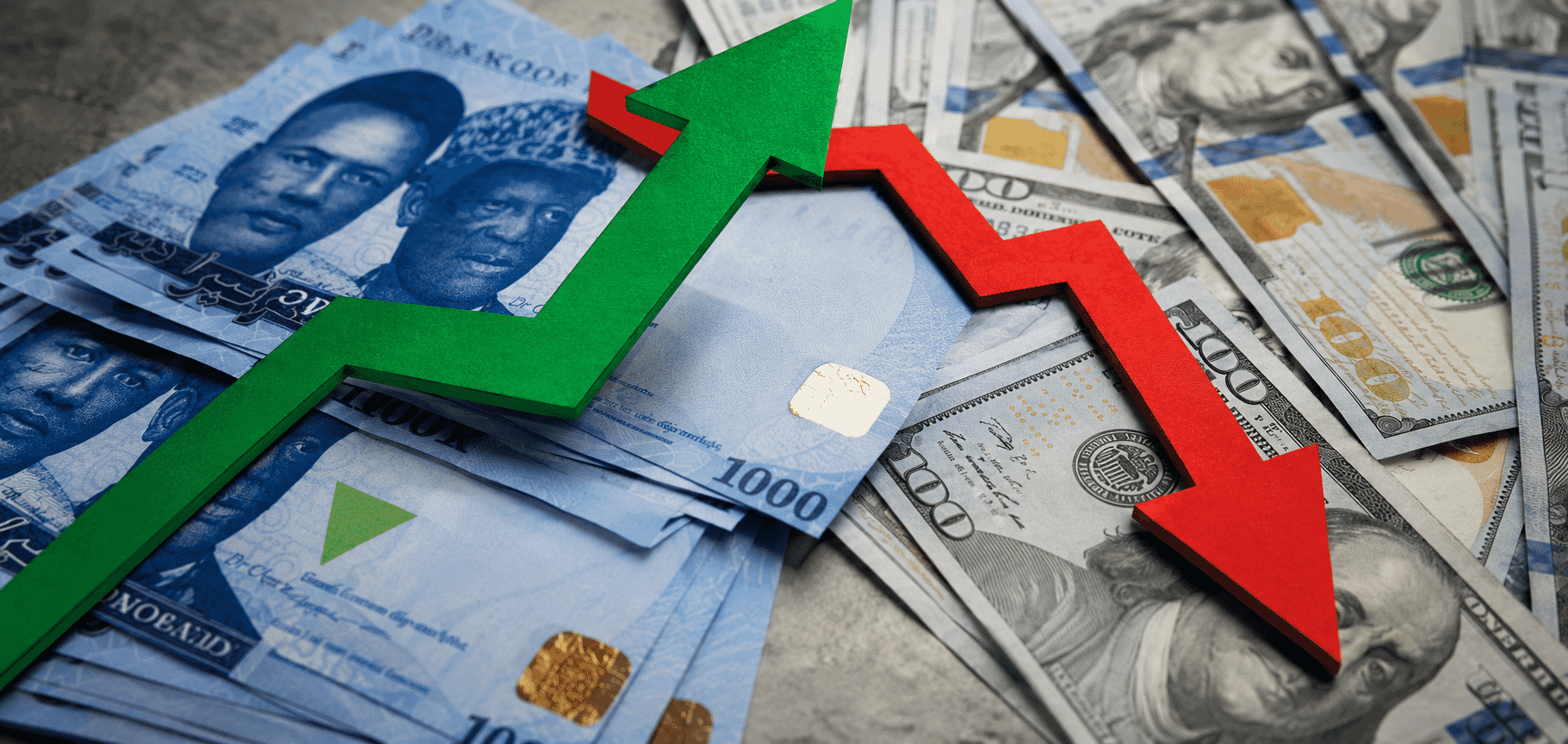
Where the Naira Stands Right Now
At the official Nigerian Foreign Exchange Market, the naira changed hands at roughly ₦1,373.99 to the dollar on Thursday, as the currency continued trading within a relatively stable range while participants watched liquidity conditions and demand.
Independent tracking from currency data provider Xe placed the mid-market rate slightly higher, at ₦1,375.98 per dollar as of 08:54 UTC that morning, a gap of barely two naira that reflects normal differences between data feeds rather than any real market split.
The parallel market, still widely called the black market, told a different story. Dealers quoted the dollar at around ₦1,410 for selling and ₦1,398 for buying, according to rates obtained from currency traders, while the official CBN window ranged between a high of ₦1,387 and a low of ₦1,376 per dollar that day.
That leaves buyers outside the formal system paying a premium of roughly ₦36 per dollar, a spread that has narrowed sharply from the chaos of previous years but has not disappeared.
 OPay Security Features Activate Emergency Lock and Safety PIN to Protect Customer Accounts
Official vs Parallel Market: Why the Gap Still Matters
The persistence of two effective rates, even a narrowed one, tells its own story about Nigeria's FX market maturity. Genuine unification would mean the spread trends toward zero, yet the gap between the official and parallel rates has held around ₦36, reflecting the continued premium paid by buyers sourcing currency outside official channels.
That premium exists because retail travelers, small importers, and students paying tuition abroad often cannot access bank-quoted dollars fast enough, so they turn to street dealers who charge for convenience and speed.
Broader data confirms the naira's relative calm this week. Trading Economics recorded the pair at 1,372.22 on July 8, up 0.07% from the prior session, with the naira down 0.90% over the trailing month but still 10.53% stronger than a year earlier. Wise's tracking shows similarly tight movement, with the currency swinging between 1,368.26 and 1,379.48 over the past week, an average of 1,372.65 and volatility of just 0.12%. Compare that to the 90-day window, where the rate ranged from 1,344.61 to 1,382.38, and the picture is one of gradual, controlled depreciation rather than a crash.
What's Actually Driving the Stability
The stability did not arrive by accident. On May 15, 2026, the CBN rolled out the Fourth Edition of its Foreign Exchange Manual, and Governor Olayemi Cardoso described the framework as reflecting the bank's commitment to a transparent, credible, market-driven foreign exchange system that supports long-term stability and investor confidence. Within days of its June 1 implementation, the effects showed up in the data. The naira appreciated by ₦5.74 to close at ₦1,361.05 at the official market, supported by improved liquidity and reserves that climbed to a record $50.04 billion.
Cardoso has repeatedly pushed back on claims that the CBN is artificially defending the currency. Briefing journalists after a Monetary Policy Committee meeting, he insisted that "the CBN's participation in the FX market does not account for much when considering total turnover, just about 1.2 to 1.3% in 2025," and dismissed suggestions the bank had been propping up the naira.
He credited a "willing buyer, willing seller" model and an electronic trading platform for cutting distortions and speculative attacks that once battered the currency.
The capital flow numbers back him up. Nigeria's National Bureau of Statistics reported capital importation of $10.37 billion in the first quarter of 2026, an 83.8% jump from the same period in 2025, with portfolio investment making up 95.1% of that inflow. Rating agencies have taken notice too. Cardoso told reporters that Fitch upgraded Nigeria from B- to B with a stable outlook, citing FX reform and monetary tightening, while Moody's raised its rating from Caa1 to B3, both signals that reform credibility, not just intervention, is doing the work.
How This Stacks Up Against Nigeria's FX History
Context matters here. Nigeria's FX market was in genuine crisis as recently as early 2024, when Cardoso inherited what he called severe macroeconomic distortions, evaporated liquidity, and a spread between official and parallel rates that had ballooned to 60%. The October 2023 unification move collapsed multiple exchange windows into one, adopting the willing buyer, willing seller principle that still governs pricing today.
Clearing a backlog of over $7 billion in unmet FX obligations was central to restoring credibility with foreign banks and investors who had effectively stopped trusting Nigeria's dollar market.
Today's ₦36 gap looks almost tame by comparison, but it is worth remembering the naira has not always moved in one direction this year. In February, the currency briefly slipped when the CBN mopped up nearly $190 million to moderate what it judged excessive appreciation, warning that a naira strengthening too fast could also hurt the economy. That episode is a useful edge case: stability, in the CBN's playbook, sometimes means slowing gains as much as defending losses.
The Mechanics: How the Daily Rate Actually Gets Set
The NFEM rate published each day is not a single trade but a calculated benchmark. The Central Bank of Nigeria states plainly that the NFEM rate is derived as a Volume Weighted Average and stands as the official exchange rate for the day. In practice, authorized dealer banks trade dollars among themselves, with customers, and with the CBN through an approved electronic platform, and the day's closing figure reflects the weighted average of those transactions rather than any single quoted price.
That mechanism explains why different trackers, Vanguard, Xe, Trading Economics, can show figures a few naira apart on the same day without contradicting each other. Each pulls its snapshot at a different point in the trading session, and intraday movement of even half a percent is normal. Anyone converting large sums should treat any single published figure as directional, not a locked-in rate, since actual bank and BDC quotes still vary.
Cracks Beneath the Headline Numbers
Not every signal points the same direction, and that is worth stating plainly. The Association of Bureaux De Change Operators has welcomed the reforms, with president Aminu Gwadabe crediting Cardoso's CBN with cultivating multiple FX sources to widen dollar access for manufacturers and retail users. Yet ordinary Nigerians still pay a real-world premium at the point of purchase, and food and import costs have not fallen in lockstep with the official rate's improvement.
There are also open questions the data cannot yet answer. It remains unconfirmed exactly how much of the naira's calm reflects durable reform versus a temporary lull in global dollar demand and softer US rate expectations. Forecasters themselves disagree on the trajectory: Coronation Research projects the naira trading between ₦1,400 and ₦1,500 in 2026, citing higher oil output and improved FX liquidity, but cautions that sustained stability depends on policy consistency and fiscal discipline. Nigeria's looming election cycle and a contentious new tax act add further uncertainty that no exchange-rate chart can fully price in yet.
Expert Insights and Case Studies
Economists note CBN's focus on reserves and unification has yielded dividends. One analyst highlighted how clearing $7+ billion in backlogs earlier improved confidence.
A case study from manufacturing: Firms with official window access saw input costs stabilize in Q2 2026, supporting output recovery versus 2024 disruptions. However, parallel-dependent SMEs struggled with inventory planning.
Yinka Ogunnubi of the Association of Corporate Treasurers has discussed FX reforms' role in fostering predictability.
What to Watch Next
The next real test comes with upcoming CBN interventions data and the August capital importation report, which will show whether Q1's inflow surge was a one-off or a trend. Reserve levels near the $50 billion mark give the CBN meaningful firepower if the parallel market gap widens further. For now, the naira's story is one of managed, incremental stability, not full unification, and that distinction will keep mattering to anyone converting dollars in Nigeria for months to come.
Read More
-
![Tinubu Inaugurates Panel to Operationalize State Police Nationwide]() President Tinubu Inaugurates Presidential Working Group to Craft State Police Implementation Bill
President Tinubu Inaugurates Presidential Working Group to Craft State Police Implementation Bill ![Aliko Dangote]() Dangote Rejects NNPC Bid to Raise Stake in $20 Billion Refinery, Eyes Public Listing for Nigerians
Dangote Rejects NNPC Bid to Raise Stake in $20 Billion Refinery, Eyes Public Listing for Nigerians-
![Dangote Refinery]() SEC Bans Dangote Refinery IPO Marketing, Orders Refunds Within 24 Hours
SEC Bans Dangote Refinery IPO Marketing, Orders Refunds Within 24 Hours ![Taiwo Oyedele]() Tax Acts 2025: Federal Government Releases Final Transition Guidelines for Nigeria's New Tax Regime
Tax Acts 2025: Federal Government Releases Final Transition Guidelines for Nigeria's New Tax Regime
 President Tinubu Inaugurates Presidential Working Group to Craft State Police Implementation Bill
 Dangote Rejects NNPC Bid to Raise Stake in $20 Billion Refinery, Eyes Public Listing for Nigerians
 SEC Bans Dangote Refinery IPO Marketing, Orders Refunds Within 24 Hours
 Tax Acts 2025: Federal Government Releases Final Transition Guidelines for Nigeria's New Tax Regime