The Nigerian Exchange Limited has rewritten the rulebook governing how stock prices move, reverting to a 2018 graduated volume framework that requires bigger trades to shift prices for premium shares. The change, confirmed this week in NGX's updated Rulebook and corroborated by multiple market operators, follows approval from the Securities and Exchange Commission. It matters because it directly changes how fast, and how much, your shares can swing in value during a single trading session.
What NGX's New Pricing Rule Actually Changes
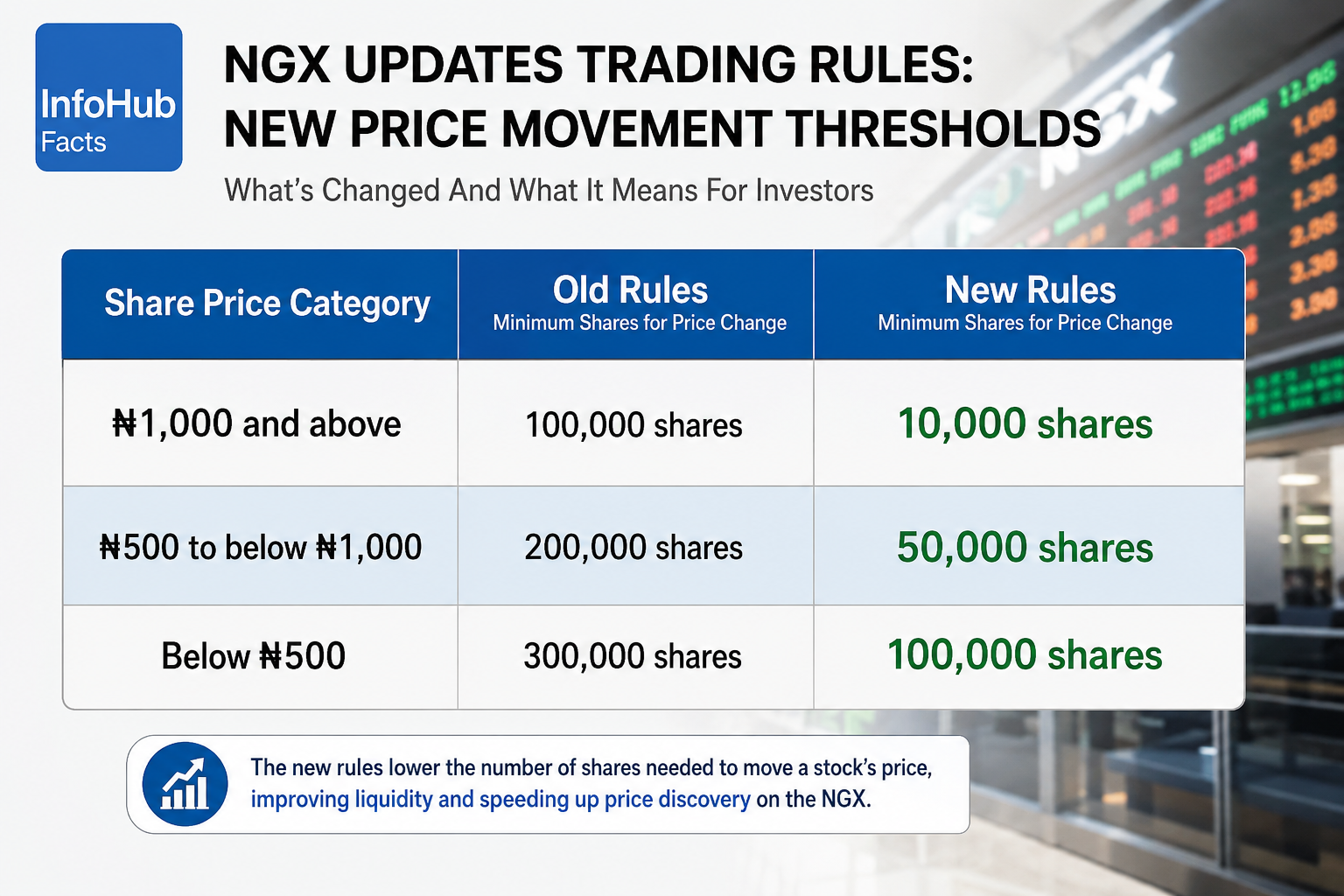
NGX has replaced a uniform 100,000-unit threshold with a three-tier, graduated system based on share price. Stocks trading at N1,000 and above will require 10,000 shares to change their price.
Equities trading between N500 and N1,000 will require 50,000 shares, while those priced below N500 will maintain the 100,000-share minimum needed to move a quoted price.
The framework groups every listed equity into three buckets: Group A (high-priced), Group B (mid-priced) and Group C (lower-priced stocks). In addition to the revised volume thresholds, NGX has formalized a tiered tick-size structure that determines the minimum price increment at which equities can trade. Group A stocks will trade in increments of 10 kobo, Group B stocks in increments of 5 kobo, while Group C stocks will continue to trade in increments of 1 kobo.
This is not a brand-new invention. It is a reversal. NGX is going back to a structure it abandoned years ago.
 Tax Acts 2025: Federal Government Releases Final Transition Guidelines for Nigeria's New Tax Regime
Why NGX Scrapped the Old Uniform Threshold
To understand the urgency here, you need the backstory. The NGX amended its Pricing Methodology rules under Rule 15.29.2.C.2 of the Rulebook, removing the graduated volume thresholds. A uniform minimum of 100,000 units was required to change the stock price of any security on the NGX, regardless of whether it was a low-priced penny stock or a high-priced heavyweight trading well over N1,000.
That single, flat rule treated a N50 stock and a N10,000 stock identically. Any trade executed below the 100,000-unit threshold was categorised by the Automated Trading System as a "small trade."
For premium, high-value stocks, that uniform rule became a straitjacket. Pushing the price of an N10,000 share required the same massive 100,000-unit trade as moving a N50 penny stock, even though the cash value involved was wildly different. That mismatch effectively froze price discovery for some of the exchange's most valuable names.
How the Rule Change Affects Premium Stocks Like Seplat and Zenith
The clearest real-world illustration comes from Seplat Energy, now trading above N10,000 per share, the first NGX stock to cross that mark. Capital market analyst Muktar Mohammed explained the practical effect using that exact stock as a case study.
"When you look at a stock such as Seplat Energy Plc trading at 11,000 naira, previously the share price movement required 100,000 units." Under the old uniform rule, moving Seplat's price meant transacting roughly N1.1 billion worth of shares before the market price would budge.
Under the new tiered structure, that threshold drops to just 10,000 units. "That means you will be able to buy 10,000 units, and it could move the price for those looking to buy or sell. It will improve liquidity in the market," he said.
Mohammed pushed back on suggestions that the lower threshold opens the door to price manipulation. "I don't think there's any concern about manipulation. But when you look at it again, it will benefit these high-cap stocks," he noted, stressing that the real challenge in the Nigerian market remains liquidity concentration rather than manipulation.
Zenith Bank, another heavyweight whose share price has recently outperformed peers like GTCO, falls into a similar conversation about how premium-tier stocks behave once volume requirements shrink.
The Logic Behind Three-Tier Price Discovery
NGX's stated rationale centers on aligning trade size with cash value, not just unit count. The Exchange's broader goal is strengthening market integrity and improving how genuine supply and demand get reflected in published prices.
For years, a relatively modest trade could trigger a price change in certain equities, particularly where liquidity was thin. This often created distortions in valuation metrics, enabled speculative trading strategies, and, in some cases, exaggerated market sentiment.
The new structure attempts to fix that distortion problem from both directions. It raises effective barriers for thinly-traded names while lowering volume barriers for genuinely high-value stocks where small unit counts still represent large sums of money.
By introducing volume-based triggers for price movements, the exchange aims to enhance the reliability of market prices and ensure that quoted values more accurately reflect meaningful trading activity rather than isolated transactions.
What Counts as a "Small Trade" Now
The classification of "small trades" carries real consequences beyond just price ticking. Transactions below 10,000 shares for Group A stocks, 50,000 shares for Group B stocks and 100,000 shares for Group C stocks will be classified as small trades and will not affect publicly reported prices.
That exclusion runs deep. Such trades will also be excluded from key market statistics, including last traded prices, daily highs and lows, 52-week highs and lows, opening prices, closing prices and relevant market indices.
This is a critical detail retail investors often miss. If you buy or sell a small parcel of shares in a heavyweight stock, your transaction may execute successfully, but it will not register on the official tape. The price you see quoted afterward will not move because of your trade alone.
How Opening and Closing Prices Are Calculated Going Forward
The amended rules also clarify mechanics that determine the reference prices investors watch every morning and evening. Opening prices will continue to be established through the Exchange's opening auction process, where the Automated Trading System calculates a price that maximizes executable volume while minimizing market imbalances.
That auction mechanism remains unchanged in principle, but the volume thresholds feeding into it now differ by stock category. A Group A auction effectively needs less unit volume to produce a valid clearing price than a Group C auction does.
Who Wins and Who Faces New Friction
Market reaction has split along predictable lines. Analysts say the framework could limit the impact of small-volume transactions on stock prices and encourage more reliable valuation patterns.
But not everyone is celebrating. Some traders have expressed concerns that the higher thresholds may slow price adjustments in less actively traded equities, potentially affecting liquidity in certain market segments.
That tension is the real story underneath the headlines. Lowering thresholds for Group A stocks unlocks faster price discovery for blue chips. Simultaneously, the 100,000-unit floor for Group C stocks, the smaller, often retail-favorite names, stays untouched. If you hold shares in lower-priced, thinly-traded companies, your stock's price may continue to feel sticky and slow to react, even as Nigeria's biggest names become more dynamic.
What This Means for Everyday Investors
If you trade premium stocks above N1,000, expect to see prices move more often and more visibly going forward, since it now takes far less volume to trigger an official change. If you hold mid-tier stocks between N500 and N999.99, the 50,000-unit threshold sits between the two extremes, offering a moderate pace of price responsiveness.
If your portfolio leans toward stocks under N500, nothing changes for you. The 100,000-unit requirement that has applied for years remains exactly as it was, meaning these stocks will likely continue exhibiting slower, choppier price movement compared to their higher-priced counterparts.
For brokers and market makers, the shift demands recalibrated execution strategies, since order sizing that worked under the uniform rule may no longer align with the new category-specific thresholds.
When Does the New Rule Take Effect
Despite the SEC's approval and NGX's Rulebook update, exact timing remains unsettled. The implementation date has not yet been announced, although market participants expect the Exchange to provide further guidance in the coming weeks.
Separately, the effective date for this new rule will soon be communicated according to Exchange officials cited in market reports. Investors should watch for an official NGX circular specifying the go-live date before assuming the new thresholds are already active in live trading.
The Bigger Picture for Nigeria's Capital Market
The policy comes at a time when regulators and market stakeholders are placing increased emphasis on transparency, liquidity and efficient price formation within the Nigerian capital market. Recent reforms have focused on strengthening investor protection, improving market efficiency and positioning the exchange to attract both domestic and foreign investment flows.
The reversal also signals something analysts rarely say outright: regulators got the 2018-to-recent-years experiment wrong for premium stocks, and they are now course-correcting in real time rather than waiting for a multi-year review cycle. That willingness to reverse a flagship rule, rather than defend it, is itself a notable governance signal for a market still building credibility with foreign institutional investors.
Watch for the NGX's formal implementation circular in the coming weeks. Once that date lands, premium stock investors should expect noticeably more frequent price ticks, while smaller-cap shareholders will see business as usual.
Read More
![CBN Building]() CBN Orders Banks, Fintechs to Disclose Ultimate Beneficial Owners in Sweeping Payments Overhaul
CBN Orders Banks, Fintechs to Disclose Ultimate Beneficial Owners in Sweeping Payments Overhaul![CBN Building]() CBN Orders Banks and Fintechs to Store Payment Data Locally, Sets January 2027 Deadline
CBN Orders Banks and Fintechs to Store Payment Data Locally, Sets January 2027 Deadline![space x]() How to Buy SpaceX (SPCX) Stock From Nigeria: Best Apps and Step-by-Step Guide
How to Buy SpaceX (SPCX) Stock From Nigeria: Best Apps and Step-by-Step Guide![Digital Switch Over]() Nigeria Digital Switchover 2026: FG Launches Nationwide DSO on June 17, Ending Analogue TV Broadcasting
Nigeria Digital Switchover 2026: FG Launches Nationwide DSO on June 17, Ending Analogue TV Broadcasting
 CBN Orders Banks, Fintechs to Disclose Ultimate Beneficial Owners in Sweeping Payments Overhaul
 How to Buy SpaceX (SPCX) Stock From Nigeria: Best Apps and Step-by-Step Guide
 Nigeria Digital Switchover 2026: FG Launches Nationwide DSO on June 17, Ending Analogue TV Broadcasting