Official CBN Rate Holds Near ₦1,382 Today
The Central Bank of Nigeria's Nigerian Foreign Exchange Market, known as NFEM, last posted an official fixing of ₦1,382.18 to the dollar on July 15. By Friday, dealers and market trackers were pricing the official rate around ₦1,380 per dollar, with only modest day-to-day movements.
The rate is derived from the volume-weighted average of transactions in the official foreign exchange market, not a single quoted price. That's a deliberate design choice from Governor Olayemi Cardoso's reform team, meant to reflect real trades rather than a fixed peg that can be gamed.
Separate tracking from Forbes Advisor, sourced through Xe, put the mid-market rate at 1 USD to 1,379.31 NGN as of July 16 at 13:59 UTC, which lines up closely with the CBN figure. Xe's own mid-market snapshot showed 1 naira equal to 0.00072 dollars, another way of writing the same story.
Black Market Dollar Surges to ₦1,422, Widening the Gap
Now the number Nigerians on the street actually pay. According to Aboki FX trackers, parallel market dealers quoted the dollar at ₦1,422 for selling and ₦1,410 for buying on Friday. That's a 4.94 percent jump from the previous day, one of the sharpest single-day street moves in recent weeks.
What's pushing the gap wider? Traders pointed to heightened weekend demand for foreign currency, combined with businesses settling international payments and travelers preparing for trips abroad. On the supply side, street-level dollar liquidity looked constrained despite recent remittance inflows, which is the classic recipe for a rate spike.
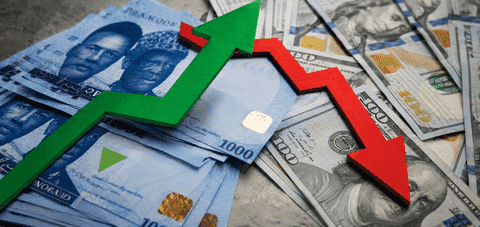 Dollar to Naira Exchange Rate Slips This Week as Black Market Rallies and the Gap Narrows
Why the Naira Is Moving: Oil, Reserves and Remittances
This is the part most "today's rate" articles skip. The naira's trajectory in 2026 is being shaped by three forces working together, and it's worth knowing all three if you want to understand where the rate goes next, not just where it sits today.
Oil money is flowing in. Nigeria still earns more than 80 percent of its export revenue from crude, so Brent crude prices move the naira almost by default. Earlier this year, Brent traded around $69 a barrel, comfortably above Nigeria's 2026 budget benchmark of $64.80, and briefly spiked above $99 a barrel amid Middle East supply fears. Every dollar above the budget benchmark is extra cushion for reserves.
Reserves have rebuilt significantly. Nigeria's external reserves stood at $49.58 billion in May 2026, up from $49.37 billion in April. That's within reach of the CBN's own year-end target of $51.04 billion for 2026, which the bank said would be driven by stronger oil earnings, sovereign bond issuance and diaspora remittance inflow. Compare that to the picture eighteen months earlier: reserves covered just eight months of imports in mid-2025, a period when the naira weakened past ₦1,600 to the dollar. Reserves now provide more than 14 months of import cover, which is the buffer keeping today's official rate from swinging wildly.
Remittances are quietly doing heavy lifting. Diaspora Nigerians sent home roughly 12 percent more money this year, according to CBN-linked analysis, with the newer Non-Resident BVN program making it easier for Nigerians abroad to bank formally rather than route cash through informal channels. Every diaspora dollar that lands in a bank account instead of a black market till is one less dollar bidding up the street rate.
Expert Take: Is the Naira Still Undervalued?
Not everyone agrees the naira has finished adjusting. Bismarck Rewane, Managing Director of Financial Derivatives Company, told the 2026 Economic Outlook organized by the Association of Corporate Treasurers of Nigeria that the naira's fair value sits closer to ₦1,257 to the dollar. By his purchasing power parity model, that means the currency is undervalued by roughly 11 percent even at today's official rate.
If Rewane is right, today's ₦1,380 to ₦1,422 range isn't the naira finding its natural level. It's the naira trading below what Nigeria's underlying economy can support, which would argue for further official-rate appreciation once reserves and reforms catch up with market confidence. That's a bullish read, but it's one analyst's model, not a certainty, and PPP calculations are notoriously sensitive to which basket of goods you use.
What This Means for Everyday Nigerians and Businesses
Importers and small businesses sourcing goods outside the banking system's official allocation are paying the black market premium, which today runs roughly ₦40 to ₦45 above the official rate. That premium gets baked straight into shelf prices.
Nigerians traveling abroad or paying school fees overseas who can't access official-window dollars face the same squeeze, often needing to source cash at the higher street rate.
Diaspora Nigerians sending money home are, in a strange twist, part of the solution. The 12 percent rise in formal remittance inflows is one of the quiet forces keeping the official rate stable, which is exactly why the CBN keeps pushing the Non-Resident BVN program.
Savers and naira-denominated investors benefit from the relative calm at the official window, since a stable NFEM rate makes naira treasury bills, currently yielding above 20 percent according to reserve-accumulation reports, more attractive to hold without fear of sudden devaluation eroding returns.
Read More
-
![President Tinubu orders NIMC to enroll every Nigerians]() President Tinubu Orders Total NIMC Enrollment of Nigerians Before 2026 Ends
President Tinubu Orders Total NIMC Enrollment of Nigerians Before 2026 Ends -
![Dangote Refinery]() Dangote Refinery Begins Selling Fuel in Dollars: What This Means for Nigerians
Dangote Refinery Begins Selling Fuel in Dollars: What This Means for Nigerians -
![ngx]() Top 10 Best Performing Nigerian Stocks in July 2026 as NGX Rally Creates New Winners
Top 10 Best Performing Nigerian Stocks in July 2026 as NGX Rally Creates New Winners -
![NGX Trading Building]() Nigerian Stocks Overtake South Korea's Kospi to Become the World's Best-Performing Market
Nigerian Stocks Overtake South Korea's Kospi to Become the World's Best-Performing Market
 President Tinubu Orders Total NIMC Enrollment of Nigerians Before 2026 Ends
 Dangote Refinery Begins Selling Fuel in Dollars: What This Means for Nigerians
 Top 10 Best Performing Nigerian Stocks in July 2026 as NGX Rally Creates New Winners
 Nigerian Stocks Overtake South Korea's Kospi to Become the World's Best-Performing Market