The Joint Action Committee of NASU and SSANU has officially declared an indefinite nationwide strike across all federal universities and inter-university centres in Nigeria, taking effect from midnight on Friday, May 1, 2026, after the Federal Government failed to present a fresh offer on non-teaching staff allowances during renegotiation talks on April 29.
Key Facts at a Glance
- Strike begins midnight Friday, May 1, 2026, across all federal universities and inter-university centres.
- Declared by the Joint Action Committee (JAC) of NASU and SSANU in a letter dated April 30, 2026.
- Government withdrew a controversial 30% allowance offer but presented no replacement.
- At the heart of the dispute: the long-stalled renegotiation of the 2009 workers' agreement.
- ASUU's renegotiation was concluded in December 2025, leaving NASU and SSANU behind.
NASU and SSANU's JAC Declares Strike Starting Midnight Friday, May 1, 2026
Federal universities across Nigeria are heading into another season of disruption. The Joint Action Committee (JAC) of the Non-Academic Staff Union of Educational and Associated Institutions (NASU) and the Senior Staff Association of Nigerian Universities (SSANU) has formally confirmed that its members will commence a total, comprehensive, and indefinite strike action from midnight on Friday, May 1, 2026.
The official strike notice arrived in a letter dated April 30, 2026, addressed to the Minister of Education, Tunji Alausa. NASU General Secretary Peters Adeyemi and SSANU President Mohammed Ibrahim jointly signed the correspondence, making the directive binding on all union members across every federal university and inter-university centre in the country.
The unions wasted no time spelling out the reason. The Federal Government, they stated, failed to conclude ongoing renegotiations and failed to table a fresh, acceptable offer on allowances before the unions' April 30 deadline. That failure, the JAC says, left them with no choice but to proceed with the strike they had been threatening for weeks.
What Triggered the NASU SSANU Indefinite Strike: Failed Negotiations and a Missed Deadline
To understand this strike, you need to go back exactly one day. On April 29, 2026, the JAC leadership sat across the table from a high-powered Federal Government delegation in a renegotiation meeting that was supposed to break the deadlock.
The government team was led by Minister of Education Tunji Alausa, joined by the Minister of State for Education Professor Suwaiba Ahmad, Permanent Secretary of the Federal Ministry of Education Abel Enitan, National Universities Commission (NUC) Executive Secretary Professor Abdullahi Ribadu, and National Commission for Colleges of Education (NCCE) Executive Secretary Angela Ajala. Senior enough to make a deal. But the meeting ended without one.
The JAC had drawn a hard line: present a fresh, substantive offer on allowances by April 30, or face a strike. The government let that deadline pass with nothing new on the table. That sealed the decision. By the evening of April 30, the strike notice was on the Minister's desk.
The 30 Percent Allowance Withdrawal That Left Workers With Nothing
Here is where the story gets particularly telling. Before the April 29 talks, the Federal Government had circulated a proposal offering a 30 percent increase in the Consolidated Non-Teaching Tools Allowance. The unions rejected it outright, calling the offer contentious and inadequate.
Minister Alausa responded by withdrawing the circular. The unions, to their credit, acknowledged that gesture and thanked the minister for pulling the contentious proposal off the table. But they drew a distinction that cuts straight to the heart of the problem.
"While the letter on the withdrawal of the consolidated non-teaching tools allowance is acknowledged, no new offer has been made to supersede it." The government took back a bad offer without replacing it with a better one.
The unions stated clearly: the withdrawal alone did not resolve the core issues in dispute. As far as NASU and SSANU are concerned, the government removed a flawed proposal from the table and left the table empty. With no alternative offer forthcoming, the unions moved forward with the strike as announced.
The 2009 Renegotiation Agreement: Nigeria's Long-Running University Labour Flashpoint
This strike does not exist in isolation. Its roots reach back to 2009, when the Nigerian government signed a landmark agreement with several university workers' unions, including ASUU, SSANU, and NASU. That agreement covers wages, allowances, and conditions of service for all categories of university employees.
The 2009 agreement was supposed to be renegotiated every three years. Successive governments allowed those review cycles to lapse year after year, turning what should have been a routine process into a recurring source of bitter industrial disputes. The result: each passing year has deepened a gulf between what workers were promised and what they actually receive.
Now, here is what makes the current situation especially frustrating for NASU and SSANU members. The Federal Government concluded a fresh renegotiation with the Academic Staff Union of Universities (ASUU) in December 2025, signing an updated agreement with academic staff. The non-academic unions, representing thousands of administrative, technical, and support workers across Nigeria's federal universities, were excluded from that process and left waiting.
That disparity sharpens the sense of injustice within NASU and SSANU ranks. Workers who have spent decades maintaining the infrastructure and support systems of Nigeria's universities feel they are being treated as second-class employees in an institution they help keep running every single day.
What the Federal University Strike Means for Students, Campuses, and the Academic Calendar
Students, parents, and university administrators need to pay close attention to what comes next. The JAC describes this strike action as "total and comprehensive," which means no partial operations and no exemptions for essential services. Every function that NASU and SSANU members handle will stop.
Non-academic staff carry a wide range of responsibilities that are invisible until they disappear. Registry offices, examination records, student services, laboratory support, library administration, facility maintenance, and financial operations all depend on the workers whose unions have now walked out. When those services stop, university life does not simply slow down. In many cases, it halts entirely.
Administrative processes such as certificate processing, student clearance, result computation, and admission handling will all be affected. With the academic calendar already stretched in many institutions, this strike adds urgent pressure on a system that cannot easily absorb another prolonged disruption.
NASU and SSANU's Message to the Federal Government: No Concessions, No Exceptions
The language in the JAC's strike notice signals no room for ambiguity. "We hereby inform the Federal Government that as a result of the failure of Government to avert the strike by positively acceding to our demands, all members will commence total and comprehensive strike action by Friday, May 1, 2026," the union leaders declared.
That statement reflects a workforce that has run out of patience. The unions are not asking for another meeting. They are not inviting another promise. They have set out their demands, watched a deadline pass, and moved to action. The ball now sits entirely in the Federal Government's court.
The unions are essentially sending one message: deliver a concrete, acceptable offer on the 2009 renegotiation, or operations across Nigeria's federal university system will remain suspended. And given the history of similar disputes in recent years, they have every reason to believe they can sustain that pressure.
Nigeria's University Strike Cycle: A Pattern the Federal Government Must Finally Break
This is not the first time NASU and SSANU have reached this point, and that history matters deeply. In 2022, a major university strike lasting eight months drew in multiple unions and forced the Federal Government to invoke a "No Work, No Pay" policy against striking workers. The fallout from that strike reverberated for years.
In October 2024, NASU and SSANU again embarked on an indefinite nationwide strike, that time demanding the release of four months of withheld salaries from the 2022 action. The government had released withheld salaries to ASUU members under President Bola Tinubu, but non-academic staff were left out of that arrangement, deepening the sense of deliberate exclusion that has now brought the unions back to the strike table in 2026.
In October 2024, NASU and SSANU again embarked on an indefinite nationwide strike, that time demanding the release of four months of withheld salaries from the 2022 action. The government had released withheld salaries to ASUU members under President Bola Tinubu, but non-academic staff were left out of that arrangement, deepening the sense of deliberate exclusion that has now brought the unions back to the strike table in 2026.
What the Federal Government Must Do Next to End the NASU SSANU Strike
All eyes now fall on Minister Tunji Alausa and the wider Federal Government. The path forward is not complicated, but it requires the political will to act decisively and quickly. The unions have stated their core demand with precision: conclude the renegotiation of the 2009 agreement and present a fresh, substantive offer on allowances that genuinely addresses the workers' concerns.
Withdrawing a rejected offer without replacing it has already cost the government its last opportunity to prevent this strike. That approach will not work going forward. What the situation demands now is a concrete, negotiated package that NASU and SSANU members can genuinely accept, not another circular that insults the workers it is supposed to serve.
University communities, students, parents, and the broader Nigerian public have a stake in seeing this resolved quickly. The longer this strike continues, the deeper the damage to an already fragile tertiary education system. The Federal Government sat across the table from union leaders on April 29 and came up empty. The next time they sit down, they must come with something real.
Read More
Exposed: New Electoral Act Provisions Allow Candidates Print Their Own Ballot Papers Ahead of 2027 Elections
![Former CBN Governor Godwin Emefiele]() Witness narrates how Emefiele moved $6.23m from CBN coffers to fund foreign observers of 2023 election
Witness narrates how Emefiele moved $6.23m from CBN coffers to fund foreign observers of 2023 election![CBN]() CBN Authorizes Fintech Banks to Recover Overdue Debts Across BVN-Linked Accounts from May 1, 2026
CBN Authorizes Fintech Banks to Recover Overdue Debts Across BVN-Linked Accounts from May 1, 2026![Google Logo]() Google Shares Skyrocket to All-Time High as Meta Slides: How AI Is Splitting Big Tech in Two
Google Shares Skyrocket to All-Time High as Meta Slides: How AI Is Splitting Big Tech in Two
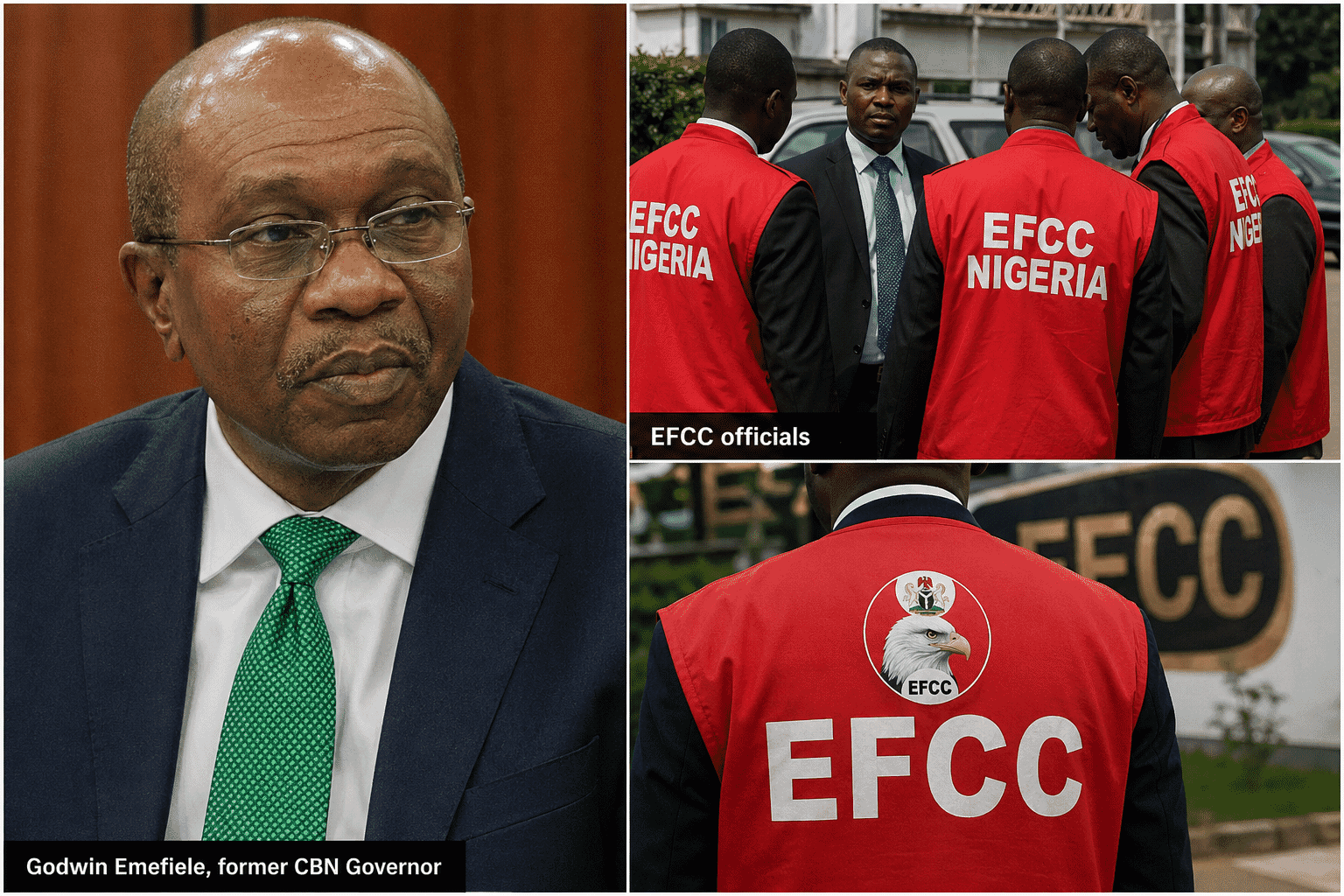 Witness narrates how Emefiele moved $6.23m from CBN coffers to fund foreign observers of 2023 election
 CBN Authorizes Fintech Banks to Recover Overdue Debts Across BVN-Linked Accounts from May 1, 2026
 Google Shares Skyrocket to All-Time High as Meta Slides: How AI Is Splitting Big Tech in Two