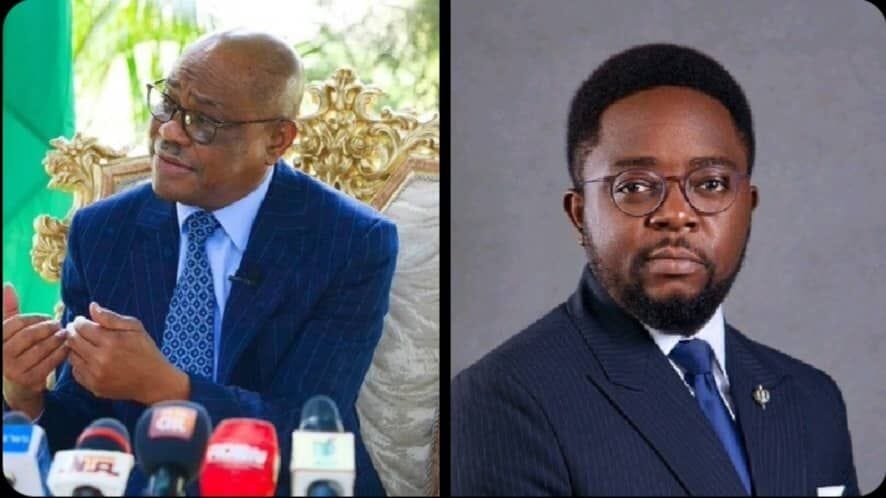
During a live media chat on Friday, April 3, 2026, Wike said: "I was thoroughly surprised yesterday when I was watching Seun's Politics Today. If there was any way to break the screen, I would have shot him."
Those words came from a cabinet minister. On live television. Directed at a journalist doing his job.
Wike added: "How can an interviewer say we cannot allow a one-party state? You are now telling them your own view, as an interviewer, that you can't allow a one-party state. I was just taken aback. I am not saying I will kill him. I am just angered that he made that kind of statement on national television."
The clarification did little to calm the storm that followed.
 US Policy Firm Moves to Brief Trump and Congress Over INEC's Decision to Freeze Nigeria's ADC
What Seun Okinbaloye Said That Triggered Wike
The controversy stems from a recent edition of Politics Today, where Okinbaloye expressed concern about Nigeria's political landscape ahead of the 2027 elections.
The journalist had earlier said it was troubling that the 2027 election conversation was beginning to look dominated by a single party, especially because of the crisis within the African Democratic Congress (ADC). Okinbaloye warned that Nigeria's democracy would be in danger if the ADC, which many see as a major opposition platform, is unable to participate in the 2027 elections.
He noted that competitive politics strengthens democracy, warning against a situation where only one dominant party remains viable. "What makes the race very interesting is when it's competitive and not when only one party stands. If this hope is dashed, we are doomed democratically speaking," the presenter said.
That is the statement that lit the fuse.
Why Wike Was Watching and Why He Reacted So Strongly
Okinbaloye's comments were in reaction to the controversy surrounding the derecognition of the African Democratic Congress (ADC) leadership by the Independent National Electoral Commission (INEC).
Wike did not see this as journalism. He saw it as advocacy.
The FCT Minister said: "How can you as an interviewer say we cannot have only one party? You are an interviewer; you are now telling them your own views. There is nothing wrong with asking your interviewee questions. But you are now the one on national television making that kind of statement, which means you have already taken a position."
Wike's core argument was that Okinbaloye had crossed the line from journalist to activist. But the response he chose to express that frustration shocked the country.
Amnesty International Calls Wike's Remark Reckless and Violent
The global human rights community did not let Wike's words slide.
Amnesty International strongly condemned the remark, calling it an incitement to violence and describing Wike's language as reckless. The organisation demanded that Wike withdraw the statement immediately and apologise.
Amnesty said: "What Wike said carries the danger of normalizing violence and encouraging the targeting of journalists for just doing their job. This level of violent intent coming from a member of Nigeria's federal cabinet is unlawful and unacceptable."
These are not the words of a fringe group. Amnesty International operates in 150 countries. Their condemnation of a sitting Nigerian minister carries serious weight internationally.
14 Civil Society Groups Join the Condemnation
A statement signed by 14 civil society groups noted that Wike's outburst undermines press freedom and freedom of expression, and demanded that he tender an apology to Okinbaloye. The groups include the International Press Institute (IPI), Nigeria International Press Centre (IPC), Media Rights Agenda (MRA), Enough is Enough Nigeria (EiE), Centre for Journalism Innovation and Development (CJID), Centre for Media and Society (CEMESO), YIAGA Africa, International Centre for Investigative Reporting (ICIR), Global Rights, Dataphyte Foundation, Accountability Lab Nigeria, and TechHer.
In their joint statement, the network called on the FCT minister to withdraw the remark, apologise to Okinbaloye and the wider media community, and openly restate his support for non-violence and press freedom as a public official.
That is a coordinated, organised response. It signals that Nigeria's civil society is treating this as a serious press freedom emergency, not a throwaway political comment.
Why "I Didn't Mean It" Is Not Enough
Wike tried to walk back the comment almost immediately. But civil society groups were not satisfied with the clarification.
The groups noted that although Wike later explained that he did not mean to physically harm the journalist, "even such hypothetical expressions of violent intent constitute a conditional threat and cannot be dismissed as harmless." They added: "Even if meant humorously, such rhetoric can be perceived as intimidation by both the journalist and the audience."
This is the key legal and ethical argument at the heart of the dispute. Intent does not erase impact. A cabinet minister saying he would shoot a journalist, even in frustration, sets a tone. It signals to others that violence against the press is acceptable anger.
The coalition stated: "We assert that conditional threats or violent statements against journalists contribute to a climate of fear, undermining the fundamental principles of a free and independent press, especially as journalists play a crucial role in informing the public and holding power to account."
Nigeria's Press Freedom Context Makes This Worse
This incident does not happen in a vacuum. Nigeria has a documented and troubling record on press freedom.
With a press freedom index ranking of 122 out of 180 countries, Nigeria remains one of West Africa's most dangerous and challenging countries for journalists. Media professionals are routinely monitored, attacked, and arbitrarily arrested, particularly during electoral campaigns.
When a minister makes a shooting threat against a journalist in that environment, it does not land as a joke. It lands as a warning. And journalists across the country take note.
The coalition warned that statements like Wike's could further expose media professionals to danger, stressing the need for public officials to communicate more responsibly.
What the Groups Are Demanding From Wike
The civil society response comes with clear, specific demands.
The network called on the FCT minister to withdraw the remark, apologise to Okinbaloye and the wider media community, and openly restate his support for non-violence and press freedom as a public official.
Amnesty went further, stating that Nigerian authorities must stop condoning lawless acts when they come from those close to power or the ruling party.
Who Is Seun Okinbaloye and Why This Matters for Nigerian Journalism
Seun Okinbaloye is not just any television personality. He anchors Politics Today on Channels Television, one of Nigeria's most-watched political programmes. His platform reaches millions of Nigerians who rely on the show to understand national politics.
When a minister singles out a journalist of that profile and makes a violent remark about him on national television, it sends a message to every journalist in Nigeria. Cover politics carefully. Watch what you say. The powerful are watching you, and they are angry.
That chilling effect is precisely what press freedom organisations warn about. It is not about one threat. It is about what that threat does to the editorial decisions of hundreds of journalists who hear it.
The Bigger Picture: ADC, INEC, and the 2027 Election Threat
Okinbaloye's original comments were about a real political crisis.
His comments were in reaction to the controversy surrounding the derecognition of the ADC leadership by INEC. He expressed the view that the country was tending towards a one-party state.
Seun was talking about the ADC after INEC decided to remove their leadership, expressing concern about what was happening in Nigerian politics.
This is a legitimate democratic concern that Nigerian journalists, analysts, and opposition figures have raised openly. The question of whether the 2027 elections will have credible opposition is not fringe commentary. It is front-page news.
The fact that a minister reacted to that concern with a shooting threat rather than a policy defence says something about how the government views press scrutiny.
What Happens Next
The pressure on Wike is now public, coordinated, and international. Amnesty International, 14 civil society organisations, and multiple press freedom bodies have all spoken.
The government has not responded formally. No statement from the presidency. No intervention from any senior official. That silence is itself a data point.
Channels Television has not publicly commented on the threat against its anchor. Seun Okinbaloye has not responded publicly either.
What is clear is that this incident has become a flashpoint in the broader debate about press freedom, political tolerance, and democratic health in Nigeria ahead of the 2027 elections.
Read More
FG Launches VehCAP to End Deadly Unsafe Vehicle Imports – Your Roads Just Got Safer
Days After Kwankwaso Joins ADC, Tinubu Requests $6bn Loan
Nigeria's 2027 Presidential Race Heats Up as Powerful Coalition Takes on Tinubu
![UK visa fees]() UK Visa Fees Set to Jump by Up to £222 Starting April 8: What It Means for You
UK Visa Fees Set to Jump by Up to £222 Starting April 8: What It Means for You![CBN]() CBN Mandates IMTOs to Settle Diaspora Inflows in Naira
CBN Mandates IMTOs to Settle Diaspora Inflows in Naira
 UK Visa Fees Set to Jump by Up to £222 Starting April 8: What It Means for You
 CBN Mandates IMTOs to Settle Diaspora Inflows in Naira