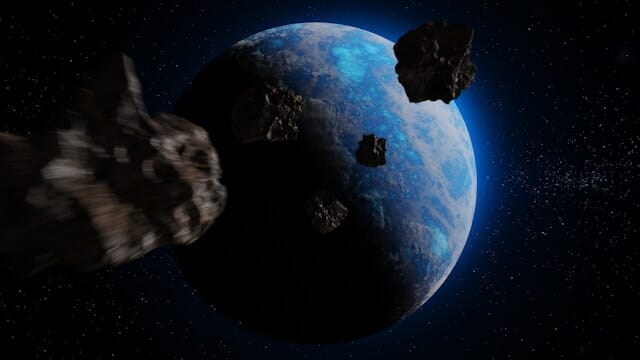
NASA's recent warning strikes a sobering chord in the scientific community and beyond. Dr. Kelly Fast, the agency's planetary defense officer, addressed the American Association for the Advancement of Science conference in Phoenix, Arizona.
She highlighted a dire vulnerability: thousands of undetected asteroids lurk in space, capable of inflicting catastrophic damage on Earth. This revelation underscores humanity's precarious position against cosmic threats, evoking a sense of urgency and unease that demands immediate attention.
 Nine Countries with Nuclear Weapons in 2025- Who Holds the Most?
NASA's Asteroid Warning Unveiled
Dr. Fast's words cut through the conference atmosphere like a meteor streak. "What keeps me up at night is the asteroids we don’t know about," she stated. Her concern focuses on mid-sized near-Earth objects, roughly 140 meters or larger in diameter. These "city-killers" possess enough power to flatten urban areas, ignite widespread fires, and cause massive casualties. Unlike tiny meteoroids that harmlessly burn up in the atmosphere or colossal planet-destroyers that scientists already track, these intermediate threats represent a critical blind spot.
Experts estimate about 25,000 such asteroids orbit in Earth's vicinity. Alarmingly, observers have cataloged only 40 percent of them, leaving approximately 15,000 undetected. These elusive rocks blend into the darkness of space due to their dim, non-reflective surfaces and Earth-like orbits, making them nearly invisible to current optical telescopes.
The inability to spot them in time means humanity lacks the means to intervene, turning potential disasters into inevitable tragedies.
The Scale of the Undetected Asteroid Threat
Imagine a silent invader hurtling through space, undetected until it strikes. Historical events amplify this fear. In 1908, the Tunguska explosion over Siberia leveled 2,000 square kilometers of forest with an asteroid under 100 meters wide.
More recently, the 2013 Chelyabinsk meteor, about 20 meters across, injured over 1,500 people and damaged thousands of buildings in Russia. These incidents evoke raw terror, reminding us that space holds no mercy for the unprepared.
Today's threats escalate with population density. A city-killer impacting a major metropolis could trigger infrastructure collapse, economic ruin, and loss of life on an unimaginable scale. Last year's near-miss with a stadium-sized asteroid, spotted only after passing closer than the Moon, exposed glaring detection failures. Such close calls stir deep anxiety, as experts warn the question is not if, but when the next strike occurs. "If one is heading for planet Earth, we may never know until it's too late," a video analysis emphasized.
Why So Many Asteroids Go Undetected Near Earth
The detection problem is not for lack of trying. NASA's ground-based telescopes spot asteroids by detecting reflected sunlight from their surfaces, but many asteroids travel alongside Earth in its orbit around the Sun, making them especially hard to find. "It takes time to find them, even with the best telescopes," Fast said.
Dark asteroids that absorb rather than reflect light are particularly hard to spot. Some travel toward Earth from the direction of the Sun, essentially hidden in the blinding glare until they are dangerously close. In December 2024, asteroid 2024 XA1 blazed over Siberia with only a few days of warning before its approach -- a reminder that sometimes astronomers notice an asteroid just days before it arrives.
NASA's Asteroid Watch dashboard tracks objects that approach within 4.6 million miles (7.5 million kilometers) of Earth, and any object larger than about 150 meters that enters this zone is termed a potentially hazardous object. But the system can only track what it can see, and that remains the fundamental problem.
Challenges in Planetary Defense Against Asteroids
NASA confronts formidable obstacles in safeguarding Earth. Dr. Fast's role involves finding asteroids "before they find us" and devising ways to deflect them. Yet, without early detection, deflection remains impossible. Even if spotted, no ready-to-launch deflector crafts exist. Nancy Chabot, DART mission leader from Johns Hopkins University, noted, "We would not have any way to go and actively deflect one right now."
Funding shortages compound the issue. Space agencies struggle to maintain standby systems amid limited resources. The stealthy nature of these asteroids – dark and fast-moving – defies current technology, leaving Earth "standing in the middle of a cosmic highway with its eyes closed." This vulnerability ignites a profound emotional response: frustration at our technological limits and fear for future generations.
How Big Is the Real Risk? Putting It in Perspective
It is important to separate alarming headlines from verified facts. NASA notes that the majority of near-Earth objects have orbits that do not bring them close enough to Earth to pose any impact risk, and the "potentially hazardous" designation simply means that over many centuries and millennia an asteroid's orbit may evolve into one with a chance of hitting Earth.
Currently, there are no other known large asteroids that have more than a 1% chance of affecting Earth, according to NASA. But the operative word is "known." It is the unknown 15,000 that demand urgent attention.
NASA's Strategies to Combat Asteroid Risks
Hope emerges amid the dread. NASA demonstrated deflection feasibility with the 2022 Double Asteroid Redirection Test (DART) mission. A spacecraft slammed into the moonlet Dimorphos at 14,000 mph, successfully altering its orbit. This breakthrough proves humans can nudge threats off course, given sufficient warning time.
To bridge detection gaps, NASA prepares to launch the Near-Earth Object Surveyor telescope next year. This infrared instrument will hunt for heat signatures from dark asteroids, aiming to catalog 90 percent within a decade. Ground-based efforts, like the Vera C. Rubin Observatory and the International Asteroid Warning Network, bolster global collaboration.
Experts advocate deflection over destruction. Methods include gravitational tugs from large spacecraft, kinetic impactors, or nuclear detonations – all requiring years of preparation. For specific threats like asteroid 2024 YR4, with a 4 percent chance of Moon impact in 2032, nuclear options draw from scenarios in films like "Armageddon." These innovations inspire optimism, transforming fear into actionable resolve.
The Urgent Call for Global Asteroid Preparedness
Dr. Fast's warning resonates as a wake-up call. Individual strike probabilities remain low, but cumulative risks demand vigilance. "We could be prepared for this threat... We need to take those steps to do it," Chabot urged. Sustained investment in science and technology offers the path forward.
Humanity's story intertwines with the cosmos. Asteroids, remnants of the solar system's birth 4.6 billion years ago, remind us of our fragility. Yet, they also fuel determination. By enhancing detection and defenses, we reclaim control from the void. This moment evokes collective emotion: awe at space's vastness, dread at its dangers, and hope in our ingenuity.
As NASA pushes boundaries, the world must heed this alert. Prioritize funding, foster international partnerships, and stay informed. The stars may hold peril, but united efforts can shield our blue planet. Act now – Earth's future depends on it.