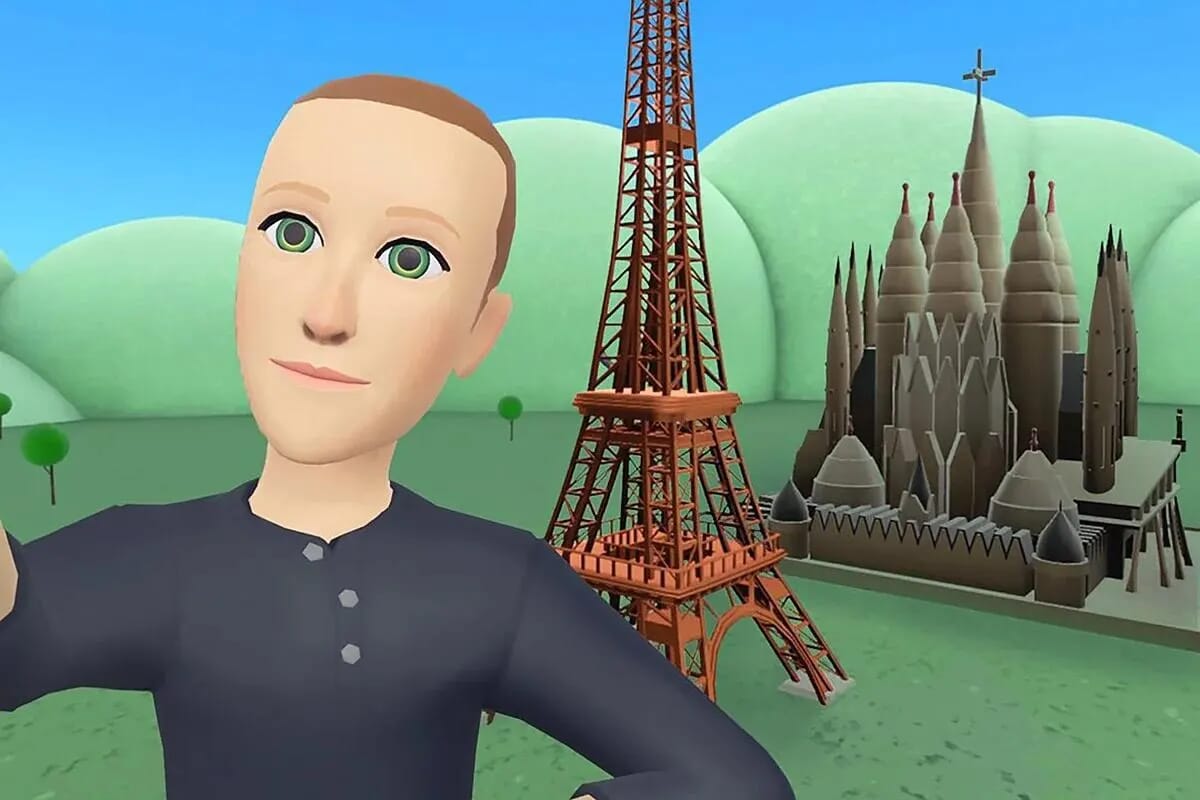
Meta just pulled the plug on a once-hyped dream. The company announced it will discontinue Horizon Worlds on Meta Quest VR headsets starting June 15, 2026. Users can no longer build, publish, or update worlds in VR after that date. The app will vanish from the Quest store by the end of March. Yet the mobile version lives on.
In October 2021, Mark Zuckerberg stood in front of the world and declared that Facebook was dead. The company rebranded as Meta, and the metaverse was its future. He promised it would reach a billion users and generate trillions in commerce.
This week, that dream effectively ended. Meta announced it would remove Horizon Worlds from Quest VR headsets, leaving only a mobile app behind. Within hours of that announcement, Meta's CTO reversed the decision.
But the damage was done. The reversal does not change the trajectory. It only confirms the chaos inside a bet that went catastrophically wrong.
 3 Reasons Why Bitcoin and the Crypto Market Are Falling, According to Crypto Experts
The Staggering Financial Losses Behind the Metaverse Shutdown
No technology bet in corporate history has burned money quite like this one. Reality Labs, the division that built the metaverse, accumulated roughly $73 billion in cumulative operating losses since 2021. In Q4 2025 alone, it posted a $6.02 billion operating loss on just $955 million in revenue.
To put that in perspective: you would need to spend $1 million every single day for 200 years to match those cumulative losses. And the losses grew year after year, with no sign of slowing.
Horizon Worlds, the social VR platform that sat at the center of this strategy, never drew more than a few hundred thousand monthly active users. That is a catastrophic failure for a project that consumed billions of dollars and was supposed to transform how humanity socializes online.
Nobody Actually Showed Up: The User Adoption Disaster
Money was only part of the problem. Users simply refused to show up. Total consumer spending on the Horizon Worlds app reached just $1.1 million since launch. That is pocket change compared to the billions Meta invested. Even the hardware failed to gain traction.
Quest headset sales fell 16% year-over-year from 2024 to 2025, according to IDC. Meta sold roughly 25 million Quest units in total. Compare that to the 3.5 billion people on Meta's Family of Apps (Facebook, Instagram, WhatsApp), and the gap tells the whole story.
Meanwhile, the platform Zuckerberg positioned Horizon Worlds to challenge, Roblox, has no hardware requirement at all and surpassed 150 million daily active users. The VR barrier to entry was never a feature. It was always the fatal flaw.
Meta was not alone in struggling. Apple had to scale back production of its $3,500 Vision Pro due to weak consumer demand, proving that the problem was not Meta's execution. The market for VR social experiences simply does not exist at scale yet.
Why Users Never Embraced Meta's Virtual World
Horizon Worlds struggled to attract real engagement. The platform never drew more than a few hundred thousand monthly active users. That number fell far short of what Meta needed to justify its vision.
Early versions faced harsh criticism. Avatars looked awkward, and technical glitches turned people off. Many users found the experience clunky compared to rivals like VRChat. Kids dominated the spaces early on, which created an unstable environment for broader growth.
Hardware barriers played a huge role too. Not everyone wants to wear a headset for long sessions. Most people simply do not own or desire VR equipment. Analysts pointed out that Meta tried to solve a consumer problem that does not really exist for the masses.
One Forrester researcher put it bluntly. He said you cannot build a mass social platform on hardware most people avoid. Advertisers followed audiences elsewhere. The virtual worlds stayed empty while real-world platforms thrived.
How AI Replaced the Metaverse as Meta's Big Bet
When ChatGPT launched in late 2022, it changed everything. Meta had an AI research division already in place, led by scientist Yann LeCun. Suddenly, generative AI was the story the market wanted, and Meta had the infrastructure to tell it. By 2024, Meta's stock had nearly tripled from its 2022 lows as investors rewarded the AI pivot.
The metaverse, by contrast, kept bleeding. The resources flowing out of VR now flow almost entirely into AI. Meta guided for $115 to $135 billion in capital expenditures for 2026, nearly double the $72 billion it spent in 2025, with the vast majority directed at AI infrastructure, data centers, and chips.
Zuckerberg has declared 2026 the year of "advancing personal superintelligence." His new vision of the future is not an avatar in a virtual world. It is AI glasses. He told investors it is hard to imagine a world where most glasses people wear are not AI glasses. Over two million Ray-Ban Meta glasses have already sold, with production capacity being doubled by the end of this year.
The Timeline: How Meta's Metaverse Dream Unraveled
Zuckerberg renames Facebook as Meta, bets the company on the metaverse, and promises a billion users within a decade.
Horizon Worlds launches on Meta Quest. Early hype quickly fades as user numbers stagnate.
ChatGPT launches. Meta begins quietly repositioning its AI narrative. Reality Labs losses deepen.
Meta lays off more than 1,000 Reality Labs employees and shuts down three VR game studios.
Reality Labs VP Samantha Ryan announces Meta will shift Horizon Worlds to a mobile-first experience.
Meta confirms Horizon Worlds will be removed from Quest on June 15. The VR metaverse is officially over.
Meta CTO Bosworth reverses course in an Instagram Q&A, saying Horizon Worlds will remain accessible in VR. A confused ending to a troubled story.
Horizon Worlds VR Shutdown: What Users Face Right Now
The change hits fast. Starting June 15, Quest users lose access to the full VR platform. You cannot create new content or interact in those virtual spaces through headsets anymore. Horizon-specific perks, like certain credits and avatar items, will disappear too.
Meta made the call clear in recent community updates. The company wants each platform to grow separately. Horizon Worlds becomes mobile-only after the cutoff. You can still jump into optimized worlds on your phone.
This decision follows months of internal moves. Meta restructured its VR efforts earlier in 2026. The pivot aims to refocus resources where they work best.
Layoffs, Studio Closures, and the Collapse of Reality Labs
The financial data tells one story. The human cost tells another. In January 2026, Meta laid off more than 1,000 employees from Reality Labs, the division that had been building the metaverse. Three VR game studios were shut down entirely.
Meta also cut significant roles across its VR division over recent months as its focus shifts toward AI wearable products and Ray-Ban Meta glasses. The infrastructure built to realize Zuckerberg's vision is being dismantled, team by team.
Meta invested $150 million in VR developers in 2025, yet closed three VR studios and laid off roughly 10% of Reality Labs in the same period. The contradiction reveals a company trying to manage a graceful exit without admitting total defeat.
The Last-Minute Reversal and What It Really Means
Meta CTO Andrew Bosworth confirmed via Instagram Stories that Meta will keep Horizon Worlds running in VR after all, reversing the shutdown announcement within 24 hours. A Meta spokesperson confirmed the reversal to TechCrunch. The June 15 shutdown date is no longer in effect.
The reversal sounds like good news for VR fans. But read it carefully. The fact that Meta planned to shut it down is proof enough that the metaverse, at least as imagined in VR, turned out to be a black hole where Reality Labs funding went to die.
Bosworth reversed course after a user reached out saying they were "heartbroken" about the decision. That a single Instagram story prompted a platform-level policy reversal tells you everything about the scale of Horizon Worlds' audience. It never achieved the mass adoption that would make these decisions complex.
Meta's mobile pivot, whether the VR version survives or not, concedes the core argument: VR hardware was never going to be the gateway to mass adoption that Meta had envisioned. The company is now chasing the 3.5 billion people already on its apps, not the 25 million who own Quest headsets.
What This Means for the Future of Virtual Reality
Meta is not walking away from VR hardware entirely. Reality Labs VP Samantha Ryan confirmed that Meta maintains a strong roadmap of future VR headsets, tailored to different audience segments as the market grows. Quest devices are not going away.
But the vision has fundamentally changed. Zuckerberg's new picture of the next generation of connection is AI agents and intelligent tools, not avatars exploring virtual worlds. The "embodied internet" he promised in 2021 has been replaced by AI bots and smart glasses.
The metaverse is not dead as a concept. But Meta's version of it, built on $73 billion of losses and a social VR platform that never found its audience, is as good as gone. Whether the next generation of computing looks like AI glasses, spatial computing, or something no one has imagined yet, it will not look like what Zuckerberg showed us in 2021.
Read More
- Samsung One UI 9 Brings Exciting Upgrades to Your Galaxy Phones- Here's What You Need to Know
- Facebook just launched a Monetization program that turns your existing audience into guaranteed cash on Facebook. Here's everything you need to know.
- Samsung Galaxy Now Lets You Communicate Even Without Cellular Network
- Meta’s Latest Safety Feature: An AI Detector Designed to Flag Emotional Manipulation and Scams