
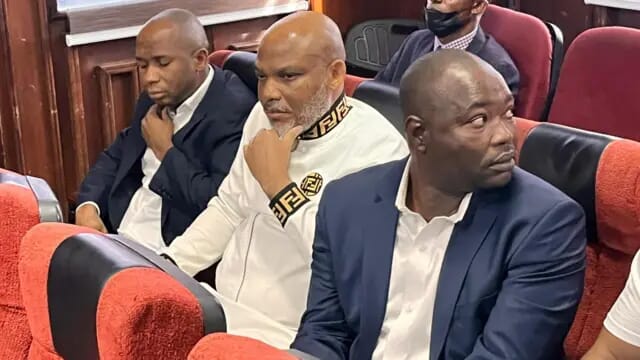
On November 20 2025, the Federal High Court in Abuja witnessed intense drama during the scheduled judgment in the terrorism trial of Nnamdi Kanu, leader of the Indigenous People of Biafra (IPOB). Justice James Omotosho ordered security operatives to escort Kanu out of the courtroom following repeated outbursts from the defendant.
Kanu interrupted proceedings as the judge prepared to deliver judgment on the seven-count terrorism charge. He insisted the court lacked jurisdiction without accepting his final written address.
Why Did the Judge Order Nnamdi Kanu Removed from the Courtroom
Justice Omotosho had earlier dismissed several fresh motions filed by Kanu, including requests for bail and referral to the Court of Appeal. The judge cited Section 306 of the Administration of Criminal Justice Act (ACJA) 2015, which prohibits stays in criminal proceedings.
When the judge began reading the judgment, Kanu shouted objections, demanding proof from the law that he could not submit a written address. His persistent interruptions prompted the order for removal to restore order.
Security agents from the Department of State Services (DSS) complied, temporarily halting proceedings.
Background of Nnamdi Kanu's Terrorism Trial and IPOB Case
Nnamdi Kanu has faced terrorism charges since his rearrest and rendition from Kenya in 2021. The Federal Government accuses him of inciting violence through Radio Biafra broadcasts and leading IPOB, proscribed as a terrorist organization in 2017.
The trial, reassigned multiple times, reached judgment stage after Kanu waived his defense in October 2025, refusing to present a defense. He argued the charges lacked validity following prior appellate rulings on his rendition.
Key Events Leading to the November 20 2025 Courtroom Drama Involving Nnamdi Kanu
Prosecution closed its case in June 2025. Kanu filed a no-case submission, overruled by the court.
In October 2025, Kanu disengaged his lawyers and opted for self-representation, leading to further delays.
Judgment fixed for November 20 2025 after dismissing Kanu's jurisdictional challenges.
Prior courtroom incidents include Kanu's protests over detention conditions and access to counsel.
Legal Implications of Judge Ordering Security to Remove Nnamdi Kanu from Court
Ordering a defendant's removal for unruly behavior is permissible under court rules to maintain decorum, as per Order 36 of the Federal High Court Rules.
However, it raises fair hearing concerns under Section 36 of the 1999 Constitution, potentially grounds for appeal.
The incident highlights tensions in high-profile trials involving separatist agitation in Nigeria's Southeast.
Reactions to Nnamdi Kanu Being Escorted Out of Court by Security Agents
IPOB supporters view the removal as further evidence of persecution, calling for Kanu's unconditional release.
Legal experts note the judge's action preserved judicial authority but may fuel narratives of bias.
The Federal Government maintains the trial follows due process, with Kanu facing consequences for non-compliance.
What Next After the Court Drama in Nnamdi Kanu's Terrorism Case
Proceedings continued briefly after Kanu's removal, with the judge standing down the matter temporarily. Full judgment delivery status remains pending, as reports indicate a pause to restore calm.
Any conviction could lead to appeals up to the Supreme Court, prolonging the case.
Political solutions, including presidential pardon calls, persist amid Southeast unrest linked to Kanu's detention.
Read More
- Five Bank Charges Nigerians Will No Longer Pay Starting January 2026
- IMF Sounds Alarm: Nigeria's Debt Trap, Oil Crash, Revenue Black Hole Exposed at World Bank 2025
- Nigeria's Push for Global Stablecoin Leadership: CBN Takes Center Stage
- Can't Run a POS Business If You Owe Bank Loans? Breaking Down the New CBN Rules